The bearing race had cracked before. Four times, on three aircraft.
What happened
On 4 November 2025, at about 17:14 local time, UPS flight 2976, a Boeing (McDonnell Douglas) MD-11F freighter, N259UP, took off from runway 17R at Louisville Muhammad Ali International Airport, Kentucky, bound for Honolulu. Shortly after rotation the left (No. 1) engine and its pylon separated from the wing, and a fire started near the left pylon's wing attachment. The aircraft struck buildings and the ground. Three crew members and 11 people on the ground were killed; the NTSB notes that one person seriously injured on the ground died 51 days later.
What the NTSB has reported
The US National Transportation Safety Board (NTSB) published an investigative update on 14 January 2026. Among its findings:
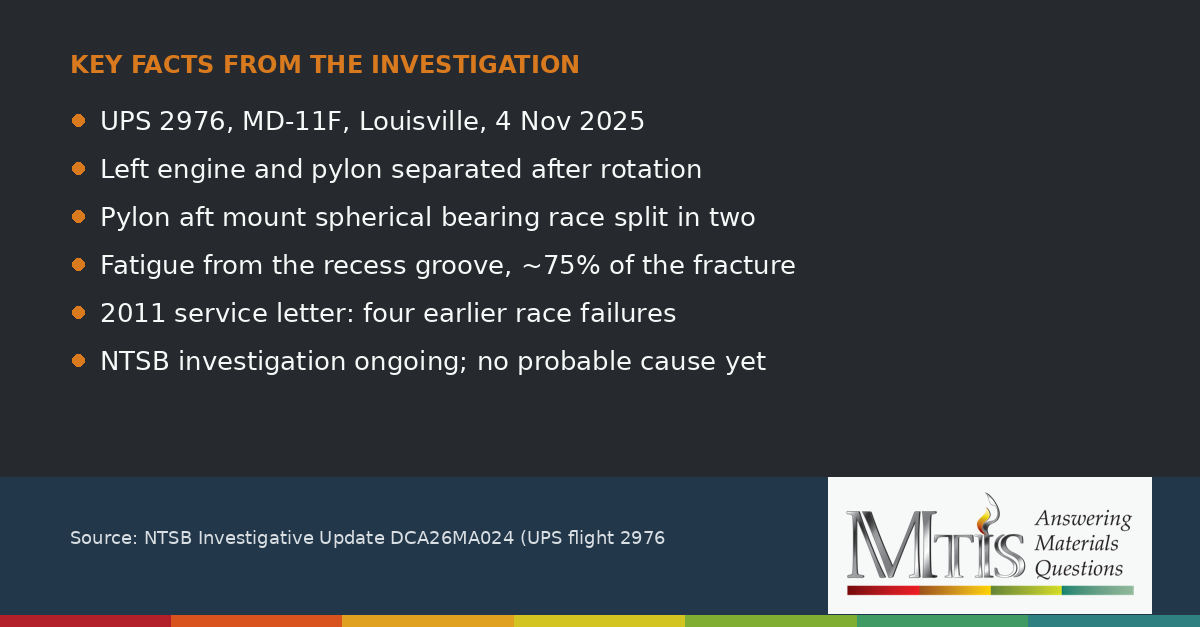
- The aft mount. The lugs of the left pylon's aft mount bulkhead were fractured. The spherical bearing race, normally a single piece, had broken into a forward and an aft portion. The bearing assembly stayed on the wing clevis.
- Fatigue at the groove. The NTSB Materials Laboratory found fatigue cracking that started around the entire circumference of the race, at the edge of a design recess groove on its inner surface. The cracking grew through the thickness and covered about 75% of the fracture surface. The remainder was consistent with overstress. Grease-like material remained between the ball and the race.
- Service history. Boeing Service Letter MD-11-SL-54-104-A, dated 7 February 2011, recorded four earlier bearing race failures on three aircraft, all with part number S00399-1, and each starting at the recess groove. Boeing determined that such a failure would not result in a safety-of-flight condition. The bearing was covered by the general and detailed visual inspections of the pylon aft mount, normally every 60 months, and the maintenance manual was updated to check that the bearing did not protrude beyond the lug faces.
- A redesigned part. A later part, S00399-523, removed the recess groove. It was recommended if an installed bearing was found unserviceable, but fitting the original S00399-1 as a replacement was not prohibited.
The investigation is ongoing. The NTSB held an investigative hearing on 19 and 20 May 2026 and has not published a probable cause. We do not suggest one.
What it means
A recess groove is a stress concentration by design. Fatigue cracks start where cyclic stress is highest, and here the laboratory found them exactly where four earlier failures had started. Nothing in that is surprising to a fatigue engineer; what is instructive is the decision trail around it.
In our view, the key question for any operator is what the original "not safety-of-flight" judgement assumed about the parts around the bearing, for example that the lugs would carry the load if the race cracked, and whether those assumptions were tested again as the fleet aged. The published update does not answer that, and the final report may.
What an engineer should check
- Do you keep a register of repeat failures at the same feature, and does anyone review it as a pattern rather than as single events?
- When a failure mode is classed as non-critical, is the reasoning written down, including what the surrounding structure must do?
- When an improved part exists, is the old part still allowed as a spare, and has that been a conscious decision?
- Does the inspection method and interval actually find a crack of the size that matters, at that location?
Source. NTSB Investigative Update DCA26MA024 (UPS flight 2976, Boeing MD-11F N259UP, Louisville, Kentucky, 4 November 2025), 14 January 2026; NTSB investigation page DCA26MA024 (status: ongoing). Read the investigative update and the NTSB investigation page. This article summarises the source in our own words; see the originals for full details. The investigation is ongoing and findings may change. It is general technical information, not advice on a specific component.
Related reading
- No defect at the origin: what the NTSB found in a fractured connecting rod
- Follow MTIS on LinkedIn for new failure reviews and industry briefings.
A repeat crack at the same feature?
Send us the failure history and photographs of the fracture faces. Request a project quote.