Home / Insights
MTIS Insights
Practical technical notes written by the engineers who do the work — how failures happen, how investigations work, and how to make better materials decisions. Every article is general technical information, reviewed before publication; none is a substitute for case-specific investigation.
Industry news and historical failures
Our readings of published failure investigations and industry news. The original investigations were carried out by the organisations named in each article, not by MTIS. Articles in the MTIS Review of Historical Failures series also show how the MTIS Failure Investigation Assistant handled the same evidence, as a test on a published case.
 Historical failure review · HF02
HF02: a crude overhead elbow lost 59% of its wall, and the steel was not the problem
The cause sat in wash water rate, dew-point margin and injection design. Plus how our FI Assistant handled the case.
 Historical failure review · HF01
HF01: a seawater condenser tube failed in under a year, and the pits were not the cause
Hydrogen sulphide in the cooling water stopped the tube protecting itself. Plus how our FI Assistant handled the case.
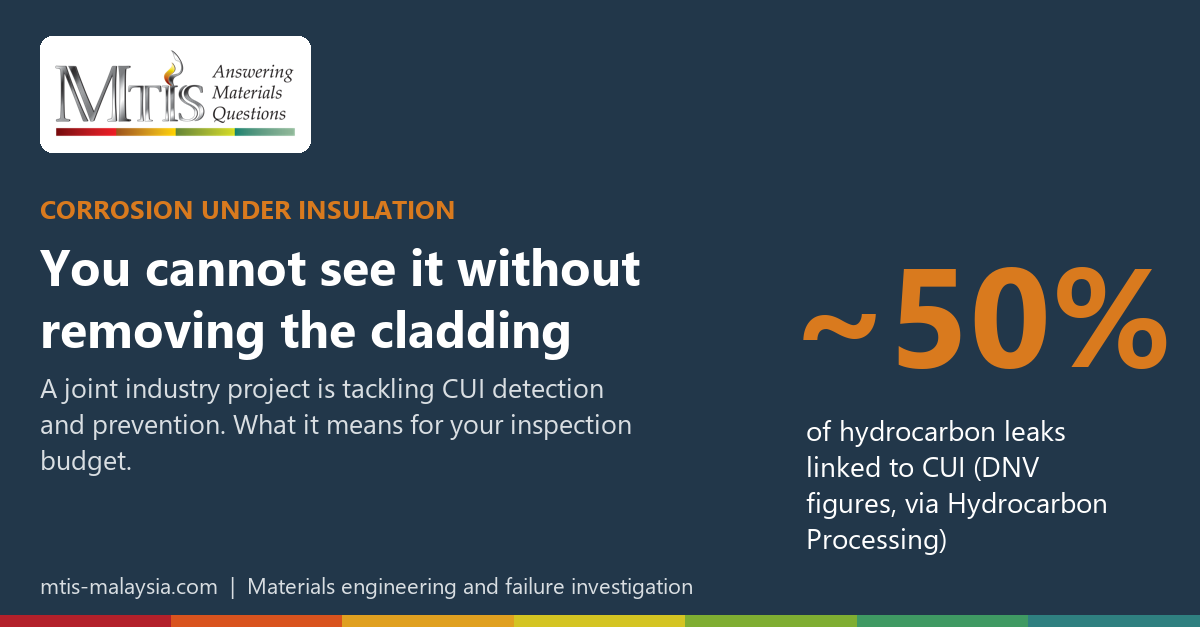 Industry briefing
Corrosion under insulation: what a new joint industry project adds
Slow wet-dry ageing tests, moisture sensors and EIS: what the CUI project reported.
 Industry briefing
API RP 1176 second edition: why the cut-out matters
The new edition leans on crack growth and remaining life. Removed sections are part of the evidence.
 Industry briefing
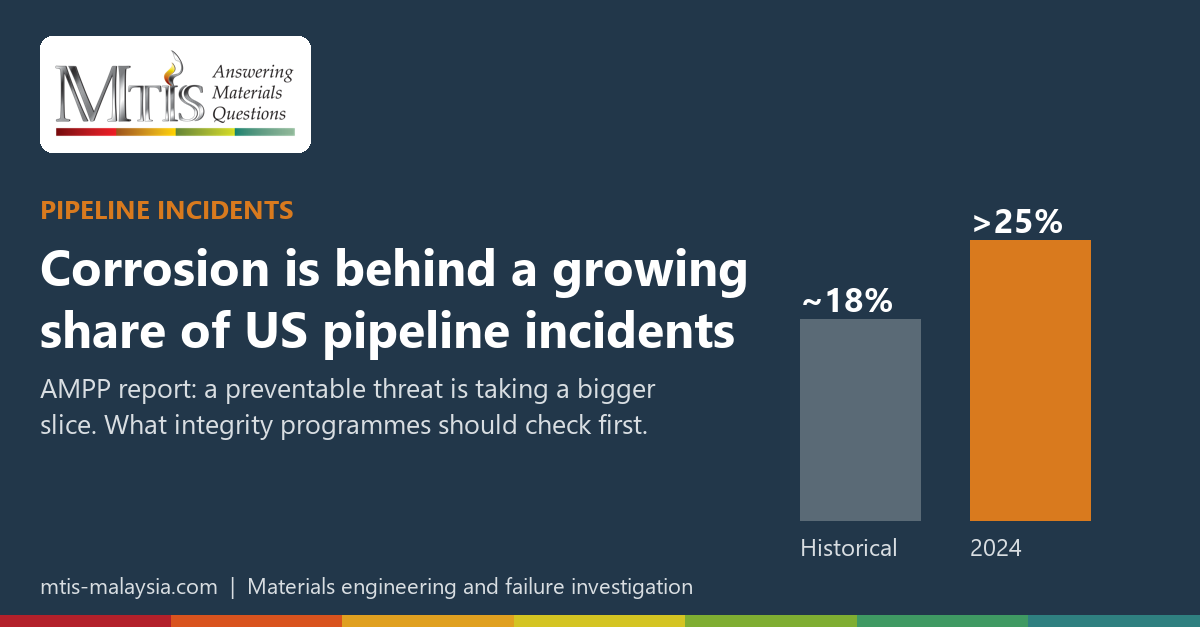
Corrosion's growing share of US pipeline incidents
From about 18% historically to more than 25% in 2024, according to an AMPP report.
 Industry briefing
Plastic pipe, hidden heat: lessons from the PHMSA advisory on Aldyl A
A corroded steam line heated the ground around a 1982 plastic tee. The materials lessons go beyond gas.
Evidence & method
What to preserve in the first 24 hours after a component fails
The evidence you save — or destroy — in the first day usually decides how good the answer can be.
Evidence handlingWhy you should never clean a fracture surface
The most common well-intentioned mistake in failure investigation — and what to do instead.
MethodRoot-cause analysis in materials failures
Why "the shaft broke by fatigue" is not a root cause — and how hypothesis-driven investigation gets to one.
MethodWhat a failure investigation report should include
A checklist for judging any investigator's report — including ours.
Testing strategyHow partner-laboratory testing supports an investigation
Why independent test-programme design beats a captive equipment list.
Testing strategyMaterials characterisation for non-specialists
What the common techniques actually tell you, in plain engineering language.
Failure mechanisms
Fatigue or overload? Reading the difference
Two failures can look identical from a distance and mean completely different things up close.
MechanismsStress-corrosion cracking: three ingredients, one failure
Material, environment, stress — remove any one and SCC stops. Finding which one to remove is the investigation.
MechanismsHydrogen embrittlement: the delayed fracture
Why high-strength fasteners break days after installation, and where the hydrogen comes from.
MechanismsPitting and crevice corrosion: reading localised attack
Why stainless steel fails in the one place you cannot inspect.
MechanismsHow a corrosion failure investigation works
From wall loss to mechanism to fix — the corrosion-specific version of the method.
Components & decisions
Boiler-tube failures: what the rupture shape tells you
Thick-lipped or thin-lipped, scaled or clean — the tube usually names its own killer.
ComponentsBolting and fastener failures
Small parts, big consequences: fatigue, hydrogen, overload and the torque that was never right.
ComponentsWeld failure investigation
Why welds fail more often than parent metal, and what a weld failure usually says about the fabrication.
DecisionsMaterials selection for corrosive environments
Why "more corrosion resistant" is not a strategy, and how to select against the actual mechanism.
Editorial standard: every article is drafted by MTIS, technically reviewed before publication, dated, and linked to the relevant service. No client-identifiable material appears in any article.
Follow MTIS on LinkedIn for new failure reviews and industry briefings.
Have a question an article can't answer?
Describe your materials or failure problem directly — that is what we are for.