A few seconds at the wrong speed was enough to fail a turbine blade.
What happened
On 12 March 2018 an Airbus Helicopters AS355F-1, VH-SEV, was making a short positioning flight at Bankstown Airport, Sydney, with a pilot and one passenger. About five minutes after take-off the pilot landed. On touchdown the right engine's chip warning light came on, a loud squeal was heard, and smoke came from the right side. The pilot shut the engine down and workshop staff put out a fire. Nobody was injured; the engine was badly damaged and the surrounding structure had minor heat damage.
What the ATSB found
The Australian Transport Safety Bureau (ATSB) found that:
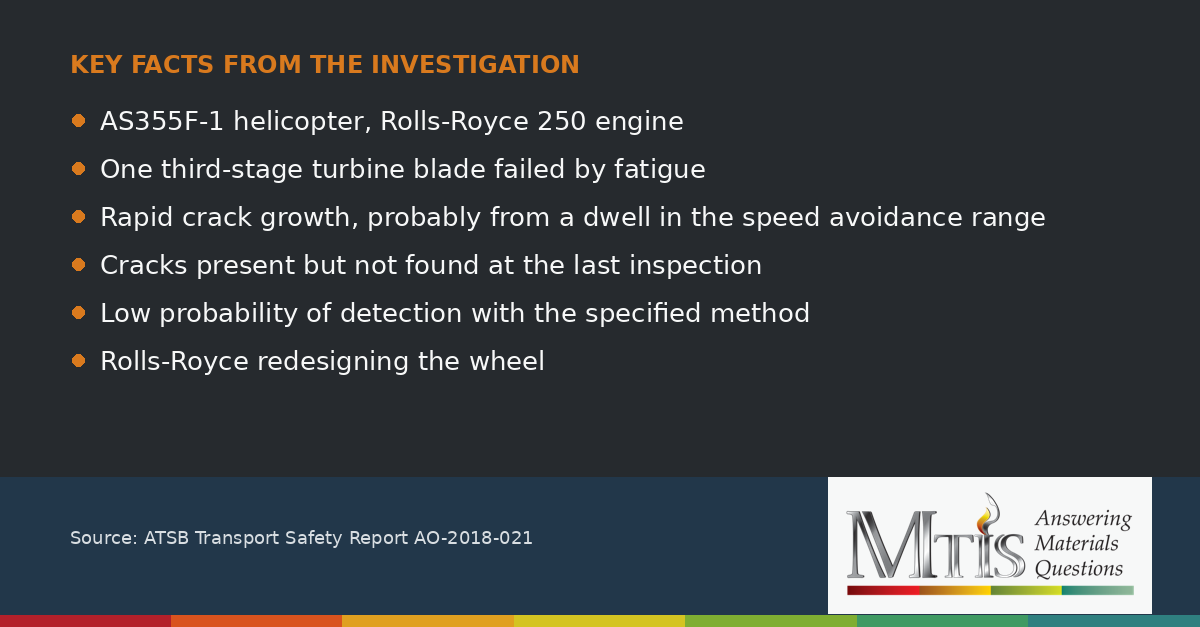
- One blade, by fatigue. A single blade on the third-stage turbine wheel of the Rolls-Royce 250 engine failed due to fatigue cracking. The released blade caused secondary damage and total engine failure.
- Rapid crack growth from a dwell. The rapid progression of the crack was probably caused by a momentary dwell in the speed avoidance range. Rolls-Royce advised that a dwell of the order of a few seconds can be enough to start damage and grow a crack to failure.
- Cracks already there. A number of fatigue cracks were present but were not detected at the last inspection of the wheel. Their size and nature meant there was a low probability of detecting them with the method specified.
Rolls-Royce is redesigning the third-stage wheel to improve its tolerance to fatigue cracking and to operation at responsive wheel modes. The ATSB advises operators to monitor engine parameters continuously and, if an inadvertent dwell in the avoidance range is suspected, to contact Rolls-Royce. The guidance given is simple: if the tachometer needle stops in the band, that counts as a dwell.
What it means
A speed avoidance range exists because a rotating part has natural frequencies. At certain speeds the excitation from the gas path lines up with one of them, and a modest vibration becomes a large alternating stress. In a turbine wheel that stress is applied many thousands of times a second, so "only a few seconds" can still mean a very large number of cycles at high stress. That is high-cycle fatigue, and once a crack is growing under resonance it can go from small to critical very quickly.
The second lesson is about inspection. An inspection interval only protects you if the method can find the crack at the size and shape it actually has. Here the cracks existed and were missed, because the method had a low probability of detecting them.
What an engineer should check
- Does your rotating equipment (turbines, fans, pumps, compressors) have documented speed bands to avoid, and is time spent in them recorded?
- When a blade or impeller fails, are the other blades on the wheel examined for cracks, not just the one that let go?
- Does your inspection method have a demonstrated probability of detection for the crack sizes that matter?
Source. ATSB Transport Safety Report AO-2018-021, Engine failure involving an Airbus Helicopters AS355F-1, VH-SEV, Bankstown Airport, New South Wales, 12 March 2018; final report released 12 March 2020. Read the ATSB report. This article summarises the source in our own words; see the original for full details. It is general technical information, not advice on a specific engine or machine.
Related reading
- No defect at the origin: a connecting rod fatigue failure
- Follow MTIS on LinkedIn for new failure reviews and industry briefings.
A blade, impeller or shaft failure to explain?
Keep all the pieces, including the parts that did not break, and send us photographs. Request a project quote.