The steel was nearly forty years old. The damage was inside it.
What happened
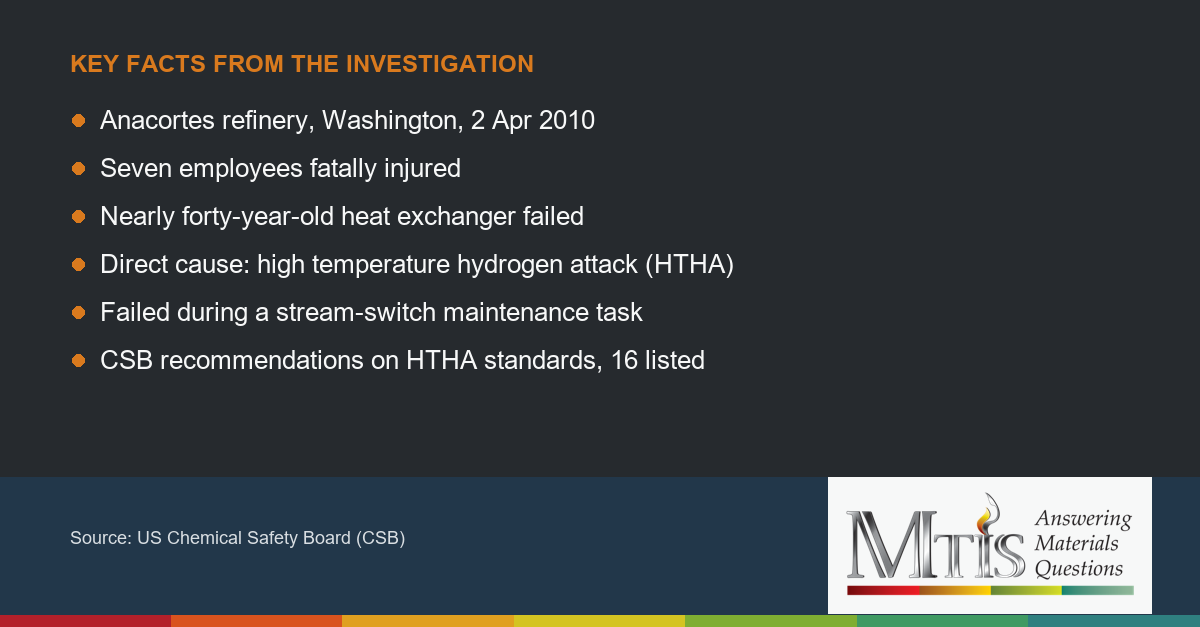
On 2 April 2010 at the Tesoro refinery in Anacortes, Washington, a nearly forty-year-old heat exchanger catastrophically failed during a maintenance operation to switch a process stream between two parallel banks of exchangers. Seven employees were fatally injured.
What the CSB found
The US Chemical Safety Board (CSB) found that the explosion resulted from high temperature hydrogen attack (HTHA) damage to the heat exchanger. The Board approved its final report 3-0 on 1 May 2014. Its recommendations went to API, the US EPA, the Washington Governor and Legislature, Washington L&I, Tesoro and the union local, and covered HTHA-related standards, inherently safer systems analysis, process hazard analysis, integrity operating windows, damage mechanism hazard reviews and process safety culture surveys.
What it means
HTHA is damage inside carbon steel that has been exposed to hydrogen at elevated temperature. It does not announce itself as thinning or as a surface crack, so a corrosion-rate survey is the wrong tool for it. In our view the main lesson is organisational as well as metallurgical: a damage mechanism that the plant has decided is not credible is the one that no inspection plan looks for, and the first sign may be the failure.
This article does not repeat details the CSB incident page does not state, such as operating conditions. For those, read the CSB report.
What an engineer should check
- Does your damage mechanism review say why each mechanism is absent, with evidence, or only that it has not been seen?
- Are old carbon steel items in hydrogen service identified, and is the basis of their selection documented?
- Does the inspection method used fit the mechanism, for example one that finds internal damage rather than wall loss?
- When standards or guidance change, is the old equipment re-assessed against them?
Source. US Chemical Safety Board (CSB), Tesoro Anacortes Refinery Explosion and Fire, 2 April 2010 (final report approved 1 May 2014). CSB incident page. This article summarises the sources in our own words; see the originals for full details. It is general technical information, not advice on a specific component.
Related reading
- Follow MTIS on LinkedIn for new failure reviews and industry briefings.
Old equipment in hydrogen service?
Send us the materials and service records for a screening review. Request a project quote