The inspection ran in 2012. It did not see the crack.
What happened
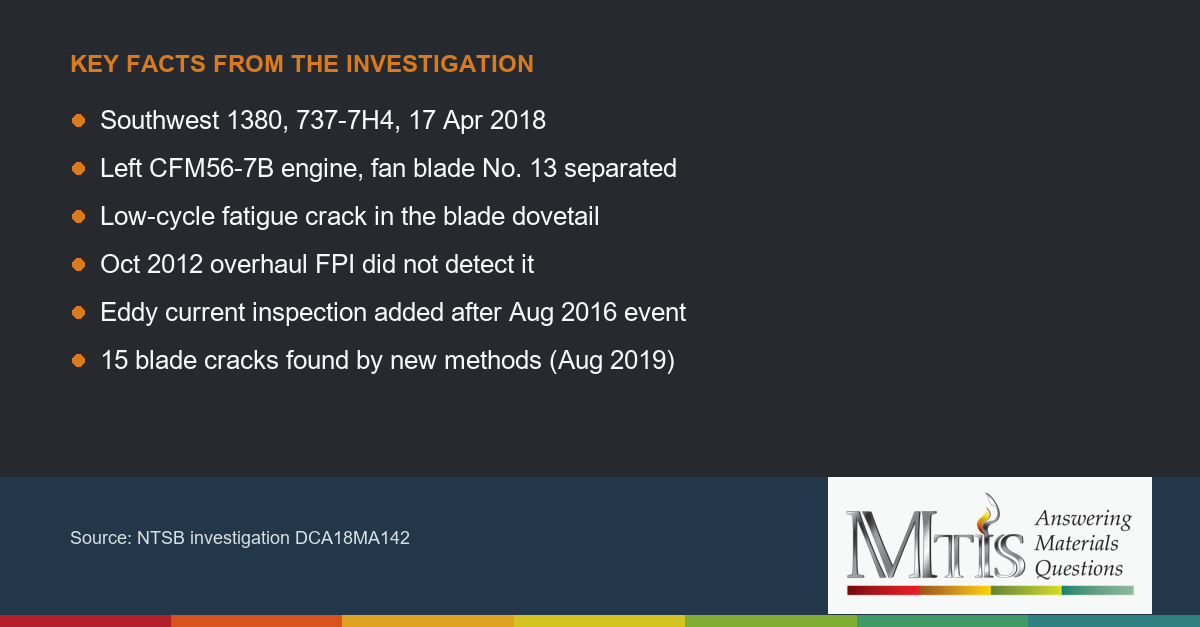
On 17 April 2018 a Boeing 737-7H4, Southwest Airlines flight 1380, was climbing through flight level 320 after departing New York LaGuardia when its left CFM56-7B24 engine failed. The aircraft landed at Philadelphia. Of the 144 passengers and 5 crew, one passenger was fatally injured and eight had minor injuries.
What the NTSB determined
- Cause. The US National Transportation Safety Board (NTSB) determined the probable cause was a low-cycle fatigue crack in the dovetail of fan blade No. 13, which separated in flight. The dovetail is the blade root, which sits in a slot of the fan disk.
- The 2012 inspection. At the October 2012 overhaul the blade was inspected by fluorescent penetrant inspection (FPI). It did not detect the crack.
- A better method, after another event. After an August 2016 fan-blade-out event on another Southwest 737-700, the engine manufacturer developed an eddy current inspection (ECI), able to detect cracks at or near the surface, to be done at overhaul in addition to FPI.
- In service. On-wing visual inspections at fan blade relubrication also missed the crack. An on-wing ultrasonic inspection was later developed for that task.
- What the new methods found. By August 2019, ECIs at overhaul or ultrasonic inspections at relubrication had identified 15 blade cracks on separate engines.
The NTSB issued seven safety recommendations (A-19-017 to A-19-023), to the FAA, the European aviation regulator and Southwest. This article does not cover their detail.
What it means
A fatigue crack at a root or dovetail is hidden by the mating part and is small when it matters. In our view the value of this case is the sequence: one method passed the part, a more sensitive method was only developed after a separate event, and the newer methods then found cracks elsewhere. "Inspected and passed" describes the method as much as the component.
What an engineer should check
- What is the smallest crack your inspection method reliably finds, at the location where cracks start, and how was that shown?
- When a better method exists, is there a plan to re-inspect parts passed by the old one?
- Are fatigue-critical features that are hidden in assembly covered by any method at all?
- After an event on similar equipment elsewhere, who decides if your inspections still fit?
Source. NTSB investigation DCA18MA142, Southwest Airlines flight 1380, Boeing 737-7H4 N772SW, 17 April 2018 (report adopted 19 November 2019). NTSB investigation page. This article summarises the sources in our own words; see the originals for full details. It is general technical information, not advice on a specific component.
Related reading
- Follow MTIS on LinkedIn for new failure reviews and industry briefings.
Not sure your inspection can see the crack?
Send us the part, the method and the inspection history for an independent view. Request a project quote