A seam weld flaw from 1956. It grew until 2010.
What happened
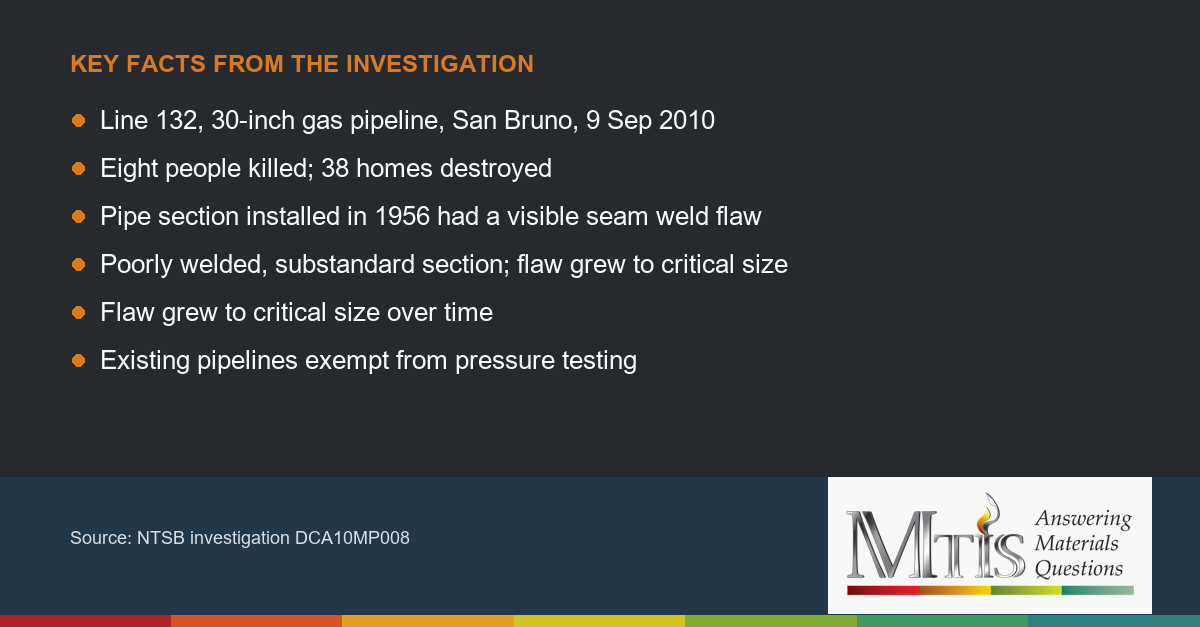
On 9 September 2010, at about 6:11 p.m., PG&E's Line 132, a 30-inch natural gas transmission pipeline, ruptured at Earl Avenue and Glenview Drive in a residential area of San Bruno, California. Eight people were killed and many were injured. The fire destroyed 38 homes and damaged 70. The ruptured section was about 28 feet long and weighed about 3,000 pounds.
What the NTSB determined
- Cause one. Inadequate quality assurance and quality control by PG&E during the 1956 Line 132 relocation project allowed a substandard and poorly welded pipe section with a visible seam weld flaw to be installed. The flaw grew over time to a critical size.
- Trigger. The pipeline ruptured during a pressure increase tied to poorly planned electrical work at the Milpitas Terminal.
- Cause two. An inadequate integrity management programme failed to detect and repair or remove the defective section.
- Contributing. The California Public Utilities Commission and the US Department of Transportation exempted existing pipelines from pressure-testing requirements.
This article does not give metallurgical test values; the NTSB incident page does not state them.
What it means
The NTSB describes a weld flaw that was visible in the pipe section and present from construction, and that grew over time to a critical size. What made it a disaster was that neither the construction quality checks in 1956 nor the later integrity programme found and dealt with it. In our view the lesson is that a flaw present from construction does not go away. It waits for the pressure, and an integrity programme that cannot see it leaves the pipe in service until it fails.
What an engineer should check
- How do you verify the weld type and condition of old sections, and not just rely on historic construction records?
- Where the condition of a section is uncertain, is that uncertainty carried into the risk assessment?
- Has the equipment ever been pressure tested to a level that would find a defect of critical size?
- What happens when a pressure increase, from any source, hits a section whose condition is unknown?
Source. NTSB investigation DCA10MP008, Pacific Gas and Electric Company Line 132 rupture and fire, San Bruno, California, 9 September 2010. NTSB investigation page. This article summarises the sources in our own words; see the originals for full details. It is general technical information, not advice on a specific component.
Related reading
- Follow MTIS on LinkedIn for new failure reviews and industry briefings.
Old welded pipe you cannot fully verify?
Send us the records and any sample or inspection data for a materials review. Request a project quote