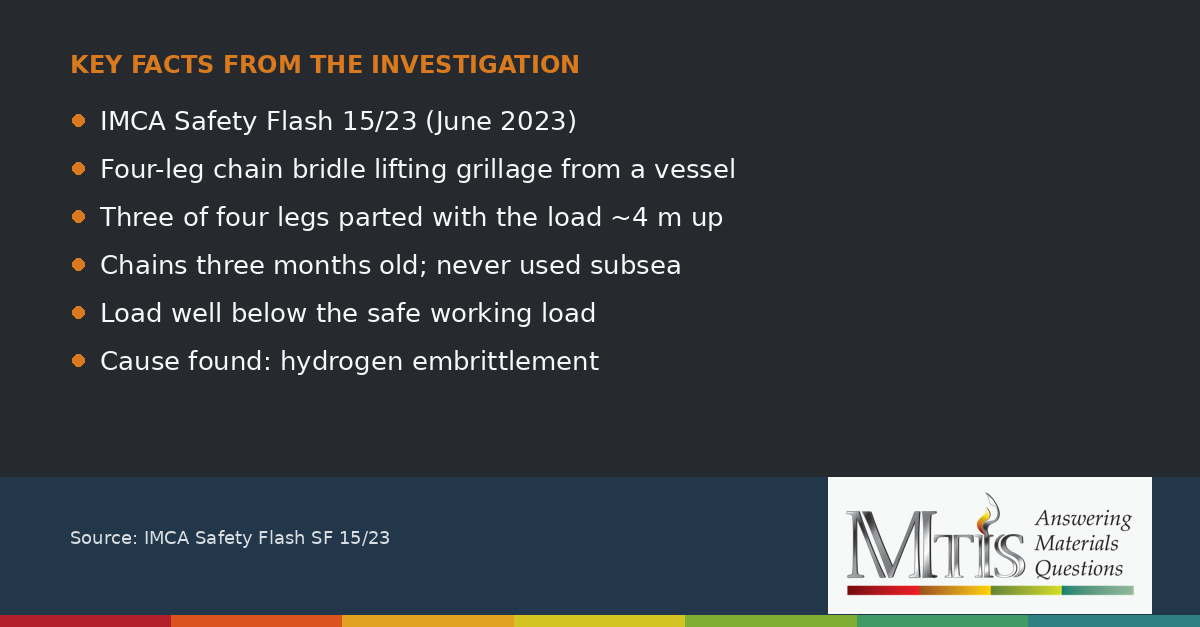
New chains, three months old. The load was well below the safe working load. Three of the four legs parted.
What happened
In June 2023 IMCA, the International Marine Contractors Association, published Safety Flash 15/23. During project demobilisation a vessel's crew was lifting sections of grillage with a four-leg chain bridle. On the last of several lifts, with the grillage about 4 m above the deck, three of the four chains parted. After a discussion between the deck foreman and the crane operator, the load was lowered slowly to the deck. No one was injured.
What the investigation found
- The chains were new. They had been in use for three months from purchase, had never been deployed subsea and were stored in a rigging locker between jobs.
- The load was light. It was well below the safe working load (SWL) of the chain.
- The cause. An independent third party and the chain manufacturer investigated. They attributed the failure to hydrogen embrittlement causing pitting, made worse by tensile load on the inner radius of the links. The failure mechanism was surface corrosion cracking leading to internal branch cracking.
- The recovery. The rigging was changed from the chain bridle to slings and shackles, and the lift was completed safely. The flash notes that the work had followed the risk assessment and lifting procedures and that the crew was competent.
The flash does not give the chain grade, size, hardness, coating or supplier, or say where the hydrogen came from.
What it means
Hydrogen embrittlement makes high-strength steel crack at stresses far below its normal strength, and the inner radius of a chain link is one of its most highly stressed points. Its signature is the one described here: failure of new, lightly loaded parts, often several at once, with branched cracking.
In our view the important question the flash leaves open is the source of the hydrogen, because it decides the remedy. In high-strength steels hydrogen is commonly introduced during manufacture, for example by acid pickling or electroplating without adequate baking, or absorbed later from corrosion in service. Hardness matters too: the higher the hardness, the greater the susceptibility. A proof-load test may not reveal it, because hydrogen cracking can develop with time under sustained load.
What an engineer should check
- For high-strength lifting chain and fittings, does the certificate include hardness as well as proof load?
- Do you know whether the chain or fittings were plated or galvanised, and whether the supplier controls hydrogen embrittlement (for example by baking after plating)?
- Are lifting items stored dry and inspected for corrosion between jobs, even when new?
- When a lifting item fails below its rated load, is it quarantined with its batch, and the fracture examined, before the rest of the batch is used again?
Source. IMCA Safety Flash SF 15/23, Lifting chains parted: hydrogen embrittlement, published 21 June 2023. Read the IMCA safety flash. This article summarises the source in our own words; see the original for full details. It is general technical information, not advice on specific equipment.
Related reading
- The chain was inspected. It still failed: hardness and the static pin
- Follow MTIS on LinkedIn for new failure reviews and industry briefings.
Lifting gear that failed below its rating?
Quarantine the batch, keep the broken links, and send us photographs. We test hardness and examine fractures for hydrogen damage. Request a project quote.