The tape had come away. The cracks grew underneath it.
What happened
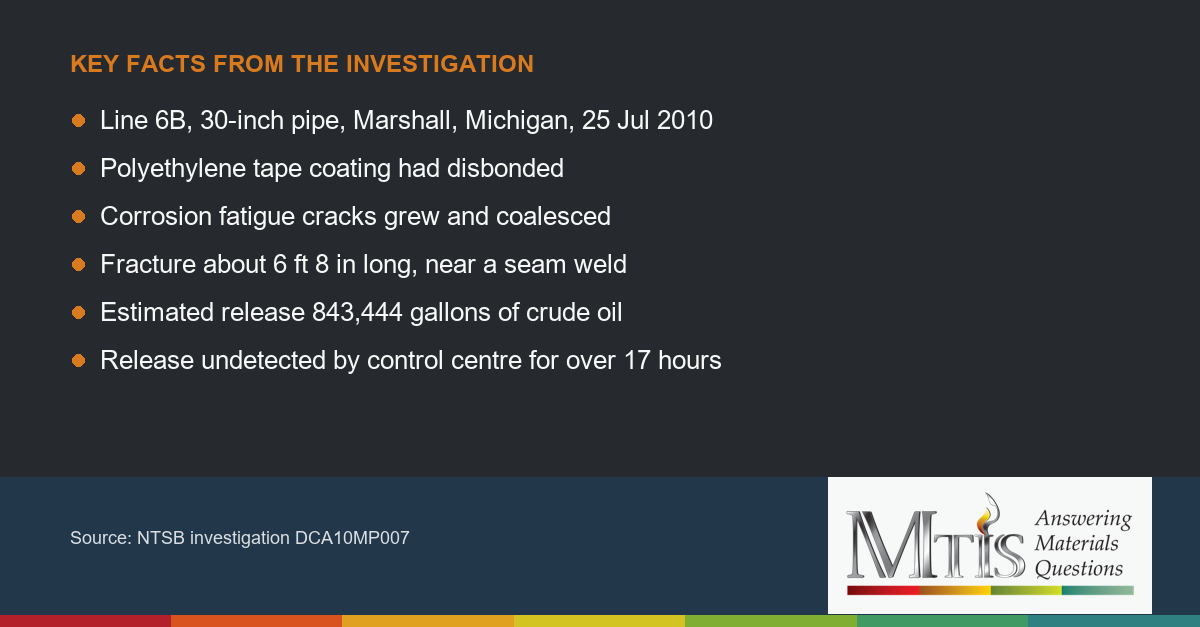
On 25 July 2010 Enbridge Line 6B, a 30-inch crude oil pipeline, ruptured in a wetland at Marshall, Michigan. The rupture occurred during the final stages of a planned shutdown and was not identified by the control centre for over 17 hours. The estimated release was 843,444 gallons of crude oil, which reached Talmadge Creek and the Kalamazoo River. No fatalities were reported. The NTSB report was adopted with clean-up costs already above $767 million.
What the NTSB found
- Cause. The US National Transportation Safety Board (NTSB) determined that the probable cause of the rupture was corrosion fatigue cracks that grew and coalesced from crack and corrosion defects under disbonded polyethylene tape coating.
- The fracture. The tape was wrinkled and had separated from the pipe at the location. The fracture ran just below a seam weld, about 6 ft 8.25 in long and 5.32 in wide at its widest opening.
- Known defects. Well-documented crack defects in corroded areas were allowed to grow until the pipeline failed. The NTSB attributed this to deficient integrity management procedures.
- Response. About 81 percent of the release occurred when additional oil was pumped into the line during two startups.
What it means
Corrosion fatigue needs three things: a corrosive environment at the steel, cyclic stress, and a place for cracks to start. A disbonded tape coating can provide the first and hide it. In our view the engineering lesson is the combination: a crack in a corroded area is not just a crack and not just corrosion, and treating the two as separate indications underestimates how quickly they interact.
The second lesson is about decisions. The NTSB reported that the defects were documented. A documented indication with no repair trigger is a list of future failures.
What an engineer should check
- Where coatings can disbond, how do you know what is under them, and by what method?
- Are crack and corrosion indications assessed together at the same location?
- Is there a written rule for when a known indication must be repaired, and a date by which it is?
- After a shutdown or alarm, who decides whether to restart, and on what evidence?
Source. NTSB investigation DCA10MP007, Enbridge Line 6B crude oil release, Marshall, Michigan, 25 July 2010 (report NTSB/PAR-12/01). NTSB investigation page. This article summarises the sources in our own words; see the originals for full details. It is general technical information, not advice on a specific component.
Related reading
- Follow MTIS on LinkedIn for new failure reviews and industry briefings.
Cracks and corrosion in the same place?
Send us the inspection data and any fracture evidence for a review. Request a project quote