What happened
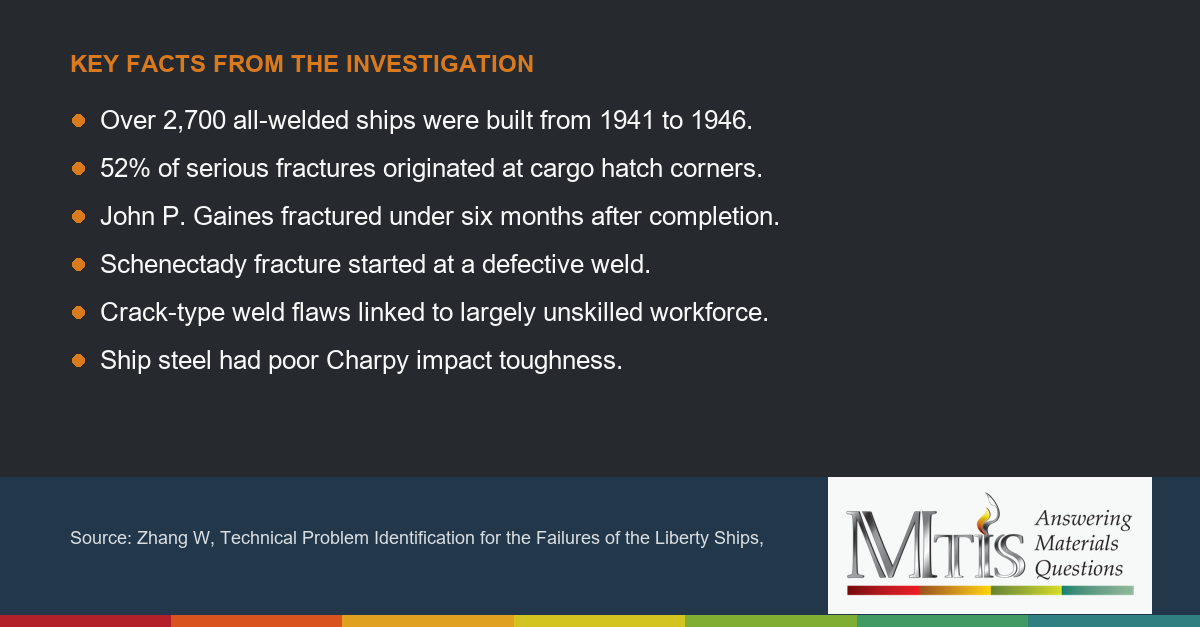
Between 1941 and 1946, more than 2,700 all-welded ships were built across 16 US shipyards. The paper does not give a total count of ships that suffered serious fractures. It describes welded hulls in which cracking became a significant technical problem, especially in cold conditions. Assembly of the John P. Gaines took place in July 1943 at Oregon Ship Building Corporation, and the ship fractured less than six months after completion, with air temperatures near 0 degrees C. The T2 tanker Schenectady broke at Portland, Oregon within days of sea trials; no date is given. The US Coast Guard requested an investigation, which found that the Schenectady fracture started at a defective weld.
What the investigators found
The paper presents several causes. Cargo hatch corners were the origin of 52% of serious fractures, citing Van Duyne. Square deck hatch corners created stress concentrations and were a major initiation point. The paper links crack-type weld defects to a workforce that was largely unskilled. The ship steel had poor Charpy impact toughness, and the mild steel fell short of modern impact-testing standards. Cold conditions encouraged a change from ductile to brittle behaviour. Some references cite hydrogen embrittlement, but the author considers it not to have been dominant. The paper lists remedies: riveted seam straps across the deck to hinder crack growth, and crack arrest provisions on the deck. It argues that steel with better low-temperature toughness and more training for welders would have avoided many failures. It does not say these changes were adopted.
Why it matters for materials and inspection
The paper connects weld flaws, Charpy impact toughness, low temperature and stress concentration at hatch corners. It reports that 52% of serious fractures began at cargo hatch corners. In our view, the case shows why inspection should consider fabrication flaws, toughness and stress concentration together rather than treating a weld defect as an isolated finding.
What changed
The paper lists riveted seam straps across the deck to hinder crack growth, and crack arrest provisions on the deck. It also argues that steel with better low-temperature toughness and more training for welders would have avoided many failures. It does not say these were adopted.
Takeaways for engineers
A caveat: this article rests on a single review paper, published as an opinion article. We have not reviewed the Ship Structure Committee reports. In our view, the practical takeaways are:
- Check cold-service welded details for credible crack paths and crack arrest.
- Treat weld flaws, Charpy toughness and stress concentration as linked variables.
- Review square hatch corners and similar details for stress concentration.
- Separate what a review paper establishes from what it recommends.
In our view, the case is a structured reminder of how material toughness, fabrication quality and detail design can combine in a brittle fracture.
Source. Zhang W, 'Technical Problem Identification for the Failures of the Liberty Ships', Challenges 7(2), 20, 2016 (open-access opinion article). Challenges paper (open access). This article summarises the sources in our own words; see the originals for full details. It is general technical information, not advice on a specific component.
Related reading
- Follow MTIS on LinkedIn for new failure reviews and industry briefings.
Cold service and welded steel?
Send us the material certificates and weld procedures for a toughness review. Request a project quote