The MTIS Review of Historical Failures takes a published failure investigation, summarises what the original investigators found, and then shows what the MTIS Failure Investigation Assistant made of the same evidence, including where it went wrong. HF01 is a worked example from the ASM Handbook on failure analysis.
What happened
A tube from a seawater surface condenser failed by pitting after less than a year in service. The tube was aluminium brass, a copper alloy widely used for seawater condensers. A section of the failed tube was sent for analysis.
What the investigators found
A thick, uneven black scale covered the whole inside surface. Under it were large pits filled with a green deposit. Cross-sections showed that the attack was intergranular, with metal grains undercut at the pit walls.
Analysis of the black scale showed mostly copper and zinc, with about 9% sulphur. X-ray diffraction identified it as mainly copper sulphide, with some zinc and aluminium sulphides. The green deposit in the pits was copper chloride.
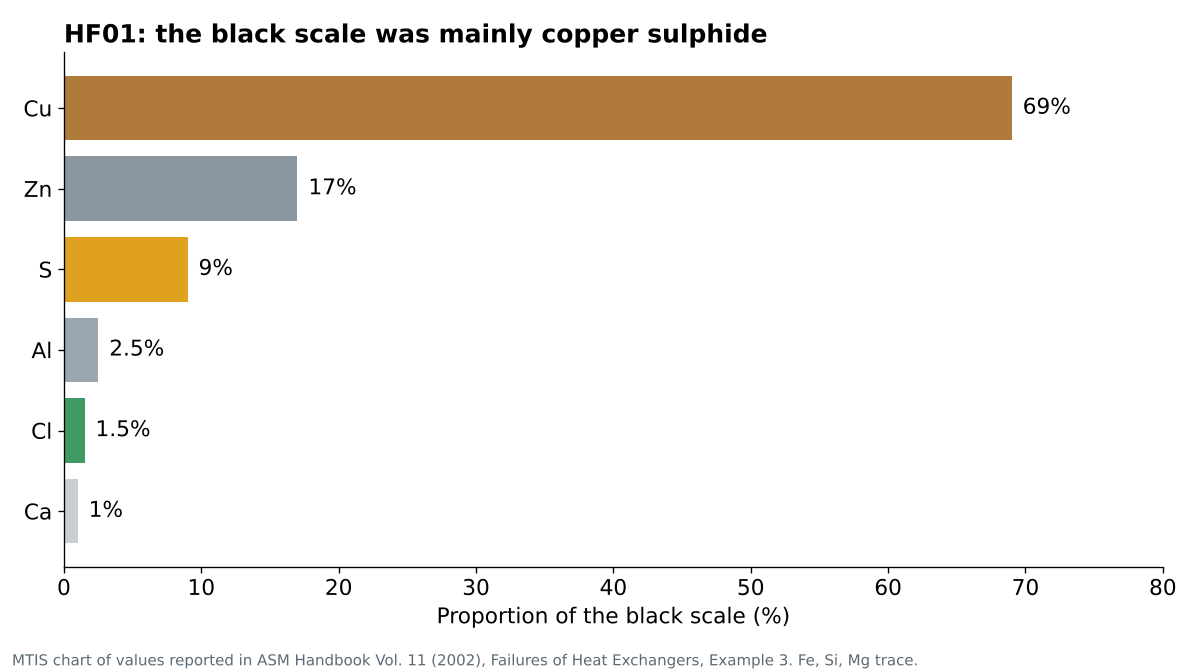
The investigators named hydrogen sulphide as the main cause. The seawater at this site carried about 5 to 10 ppm of it. Copper alloys depend on a protective oxide film in seawater. Sulphide stops that film forming and leaves a sulphide scale instead, which does not protect the metal and lets chloride build up underneath it. The likely source was sulphide-bearing sludge collecting in coral formations near the condenser intake.
Their recommendations were to remove the source of sulphide, and to consider dosing ferrous sulphate just upstream of the condenser to help a protective film form.
What it means for asset owners
The tube alloy was a normal choice for ordinary seawater. The water at this site was not ordinary. Pitting was how the tube failed; hydrogen sulphide in the cooling water was why. Replacing tubes like for like would have repeated the failure, because the cause sat in the intake water rather than in the metal.
What an engineer should check
- Has the cooling water at your site been analysed for sulphide, or was the tube alloy chosen on the assumption of clean seawater?
- What sits near the intake: sludge, stagnant pockets, discharges? Any of these can change the water the tubes actually see.
- On a failed tube, is the deposit analysed before cleaning? Sulphur in the scale on a copper alloy is a direct pointer. See why surfaces should not be cleaned before examination.
- If tubes are replaced, has the water been corrected first, or the material reselected for the water you actually have?
How the MTIS Failure Investigation Assistant handled this case
Test on a published case, not an accuracy claim.
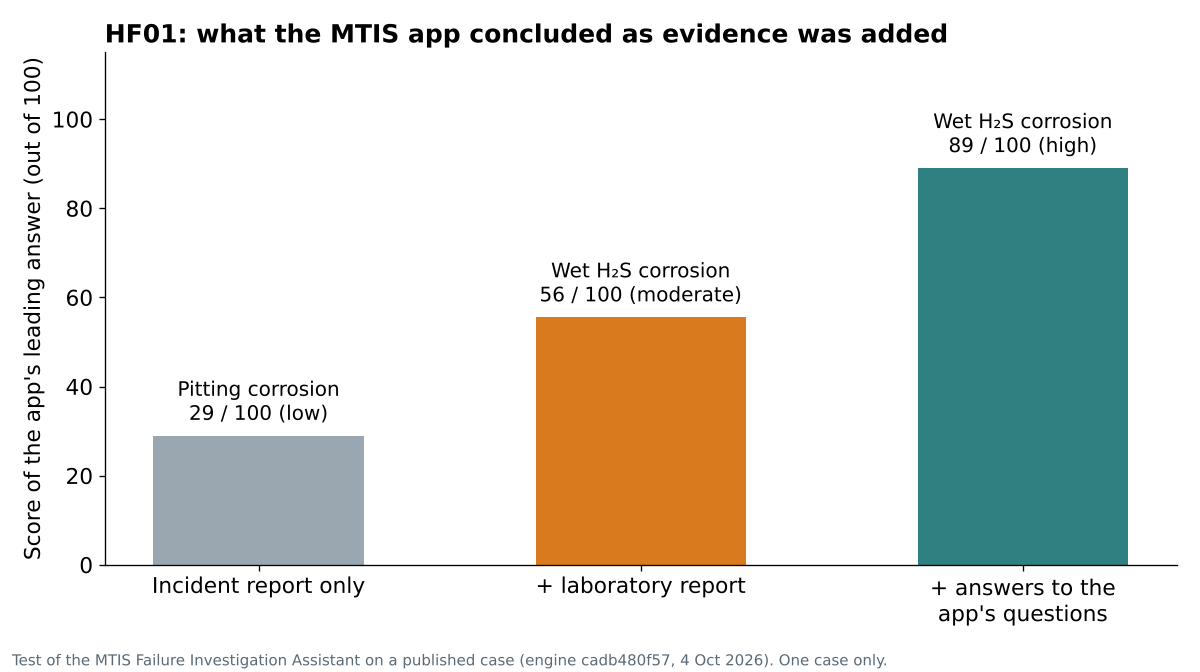
MTIS built a test case from the handbook example. The incident report described the tube, the black scale, the green pit deposit and the intake near coral, without the laboratory results. We then gave the app the evidence in three steps. One run, engine version cadb480f57, 4 October 2026.
| Evidence given to the app | App's leading answer | Score | Rank of wet hydrogen sulphide corrosion |
|---|---|---|---|
| Incident report only | Pitting corrosion | 29.0 / 100 (low) | 3rd |
| + laboratory report (EDS, XRD, metallography, seawater H2S) | Wet hydrogen sulphide corrosion | 55.6 / 100 (moderate) | 1st (runner-up 44.3) |
| + answers to the app's own questions (25 asked, 5 answerable from the case) | Wet hydrogen sulphide corrosion | 89.1 / 100 (high) | 1st (runner-up 72.9) |
What it missed or could not do
- From the incident report alone, the app led with pitting corrosion. That describes what the damage looks like, not what caused it. Wet hydrogen sulphide corrosion was third.
- Even with the laboratory report, the runner-up was close behind (55.6 against 44.3).
- 20 of the 25 questions could not be answered from the published case and were left as unknown.
- The app's root-cause step was not run. The source of the sulphide (sludge in coral near the intake) comes from the handbook, not from the app.
- MTIS wrote the case knowing the answer. This is one case, one run.
Source. ASM Handbook Volume 11, Failure Analysis and Prevention (ASM International, 2002), chapter "Failures of Heat Exchangers", Example 3: "Pitting of a Condenser Tube in a Saltwater Heat Exchanger Due to Hydrogen Sulfide Contamination". The charts on this page are MTIS charts of values reported in that example; no figures from the handbook are reproduced. This article summarises the source in our own words; see the original for full details. It is general technical information, not advice on a specific asset.
Related reading
- Pitting and crevice corrosion: reading localised attack
- How a corrosion failure investigation works
- Materials selection for corrosive environments
- MTIS materials selection services
Follow MTIS on LinkedIn for new failure reviews and industry briefings.