What happened
On 17 October 2000, near Hatfield, four people were killed and 70 injured when coaches derailed at 185 km/h. The high rail was 56 kg/m, rolled by British Steel (now Corus), laid in 1995, mill heat treated to improve wear resistance, and only slightly worn. It sat on a curve of 1462 m radius.
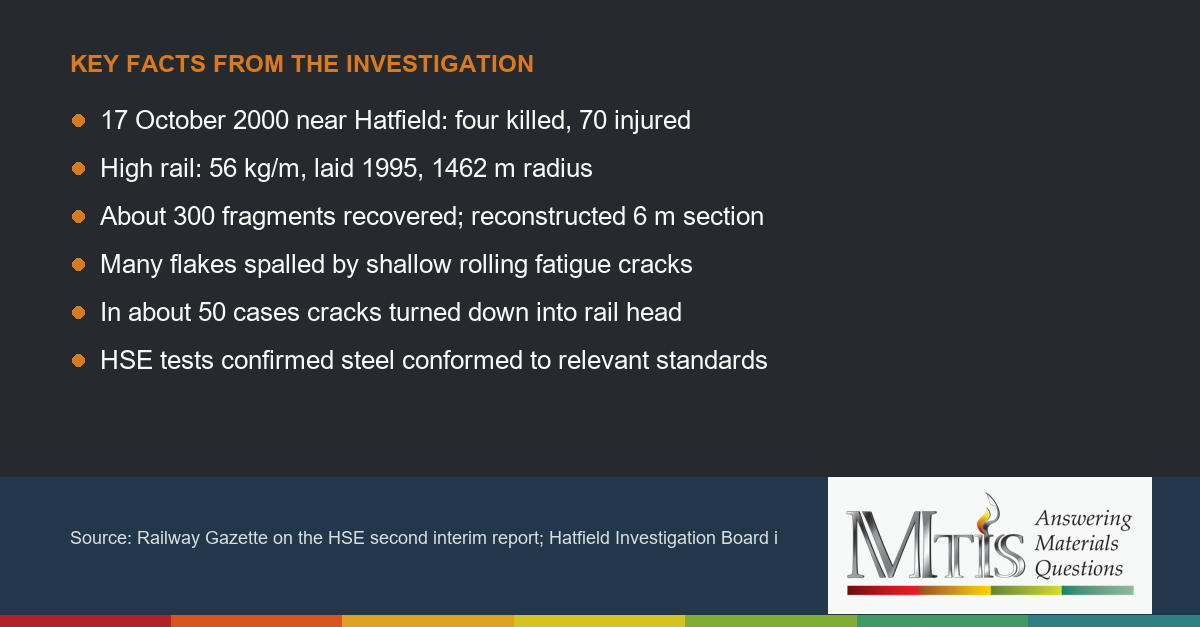
The rail suffered an initial transverse fracture and then shattered. About 300 fragments were recovered. A reconstructed 6 m section showed fragments no more than 1 m long, and the source attributes the breakup mainly to brittle fracture.
What the investigators found
Many fragments were flakes spalled from the running surface by rolling fatigue cracks at shallow depth. One flake measured 100 mm x 30 mm x 3 mm deep. In about 50 cases, fatigue cracks had turned down from the running surface into the rail head. Extensive spalling pre-existed, and some pits were rusty while others were fresh.
HSE laboratory examination and tests confirmed that the steel conformed to relevant standards. The rail had been inspected in January 2000 and several times afterwards. Its surface condition indicated a need for an immediate speed restriction and early replacement; the report was silent on this pending decisions on prosecution of Railtrack and its track maintenance contractor Balfour Beatty.
The Hatfield Investigation Board, chaired by Sandra Caldwell, said the immediate cause was fracture and subsequent fragmentation of the track. The rail had multiple cracks and fractures due to rolling contact fatigue. A train at the permitted speed passed over a rail identified as in poor condition that should have been replaced or placed under a temporary speed restriction.
Why it matters for materials and inspection
The rail was only slightly worn, yet it carried multiple shallow rolling fatigue cracks and extensive spalling. The crack population included flakes at the running surface and cracks that had turned down into the rail head.
In our view, inspection and maintenance decisions therefore need to link surface condition, crack orientation and maintenance action when judging whether a rail can remain in service.
What changed
The Hatfield Investigation Board's interim recommendations included for Railtrack to implement current best practice for detecting rolling contact fatigue and to investigate automated train-borne detection and methods for detecting defects in a wider range of orientations, including eddy current and alternating current field measurement. The recommendations also called for a clear track maintenance statement and programme with performance-based standards, a rail-condition database and a proactive deterioration strategy. They included improving understanding of rolling contact fatigue, including predicting when cracks turn down to become transverse, and reviewing track and rolling stock design to reduce rolling contact fatigue risk.
Takeaways for engineers
In our view, the practical takeaways are:
- Wear alone is not a sufficient indicator of rail condition where rolling contact fatigue is present.
- Shallow surface flakes and cracks that turn down into the head need to be considered together.
- Inspection findings should be tied to speed restrictions and replacement decisions.
- Detection methods should cover defects in a wider range of orientations.
- A rail-condition database and proactive deterioration strategy support consistent decisions.
Source. Railway Gazette, 'How the rail shattered at Hatfield' (reporting the HSE second interim report); Health and Safety Commission press release and Hatfield Investigation Board interim recommendations, 22 August 2002. Railway Gazette; HSC release. This article summarises the sources in our own words; see the originals for full details. It is general technical information, not advice on a specific component.
Related reading
- Follow MTIS on LinkedIn for new failure reviews and industry briefings.
Surface cracks you are managing, not removing?
Send us the inspection history for a rolling contact fatigue review. Request a project quote