The brakes passed their static test. They could not stop a moving load.
What happened
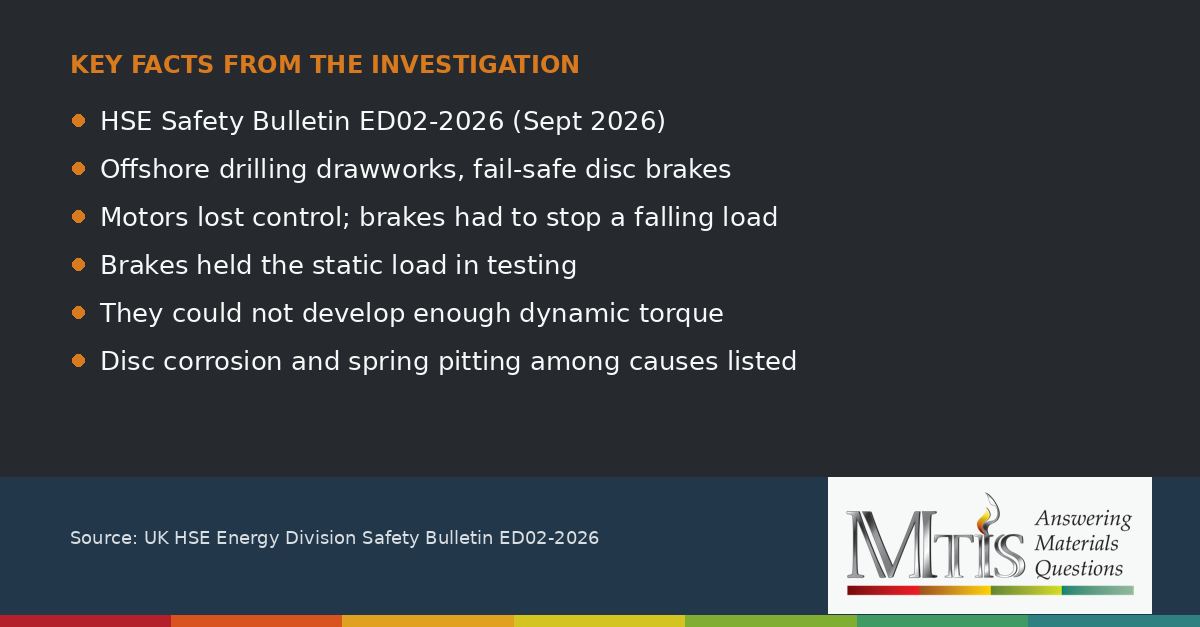
In September 2026 the UK Health and Safety Executive (HSE) Energy Division issued Safety Bulletin ED02-2026 to offshore installation operators and to manufacturers and suppliers of drilling equipment. It concerns drilling drawworks driven by electric motors, which use disc brakes as the fail-safe means of stopping and holding the travelling system in an emergency.
On these machines the electric motors normally control the load. The disc brakes act mainly as parking or static holding brakes, but they must also work as the emergency fail-safe.
HSE investigated an incident in which the motors could no longer control the load, and the disc brakes had to stop a descending load. They could not generate enough dynamic braking torque to do so, although earlier testing had shown that they could hold the static load.
What HSE found
- The test did not match the duty. Static tests measure holding capacity only. They do not show whether the brakes can stop a moving load.
- Hidden degradation. Loss of dynamic braking performance was not revealed by routine testing; it showed only when the brakes were needed in a real emergency.
- Unclear standards. Industry specifications did not clearly require dynamic testing of the emergency brake function, and testing, commissioning and maintenance standards may not have proved the fail-safe function.
- Causes of lost braking. HSE lists, as not exhaustive: contamination, disc corrosion, component wear, tolerance and alignment, broken springs, brake pad ageing and compression cycles, poor maintenance, inadequate design assessments, missing manufacturer information, the thermal capacity of the disc and pad, and changes to consumable parts. Enclosed and open derricks can affect these differently.
HSE asks duty holders to review their safety case and the manufacturer's failure modes and effects analyses (FMEA and FMECA), and to inspect the whole braking system, in particular:
- brake disc rotors for corrosion and pitting;
- hinged joints for excessive wear;
- springs in the brake cylinders for cracks, breaks, corrosion and pitting;
- brake cylinders for water or moisture ingress;
- callipers and pads set to the manufacturer's critical tolerances.
Manufacturers are asked to show that the brakes are rated for emergency dynamic use in the worst allowable condition, such as broken springs or the maximum wear gap, to identify degradation that develops when brakes are rarely applied dynamically, and to set wear limits.
What it means
In our view much of this list is materials engineering. A disc brake that spends its life holding a stationary load is rarely asked to absorb energy, so the faults that reduce stopping torque can build up unseen: a corroded or pitted friction face changes the friction behaviour, and a corroded, pitted or cracked spring in a spring-applied brake cylinder loses force or breaks. Water ingress in a marine environment accelerates both. A static holding test with good margin can still pass while all of this is happening.
The same logic applies to any rarely used safety system in a plant: emergency brakes on cranes and winches, spring-return actuators, and relief devices. Test what the system must do, not what it is easy to test.
What an engineer should check
- Does the test of each emergency system prove its emergency duty (stopping, closing, relieving), not a proxy?
- Are springs in fail-safe actuators inspected for corrosion pitting and cracking, and replaced on condition or age?
- Are friction faces inspected for corrosion after periods of low use, especially offshore and in humid climates?
- Are wear limits and the worst allowable condition defined, so that "within limits" means "still able to stop the load"?
Source. UK HSE Energy Division Safety Bulletin ED02-2026, Drilling drawworks: fail-safe system disc brakes (issued September 2026). Read the HSE safety bulletin. This article summarises the source in our own words; see the original for full details. It is general technical information, not advice on specific equipment.
Related reading
- Eleven safeguards against a known fatal hazard: engineered versus administrative controls
- Follow MTIS on LinkedIn for new failure reviews and industry briefings.
Springs, discs or brake parts showing corrosion or cracks?
We examine failed and suspect components and tell you what the damage means for service. Request a project quote.