The corrosion check found no corrosion. 40 flying hours later the landing gear leg broke.
What happened
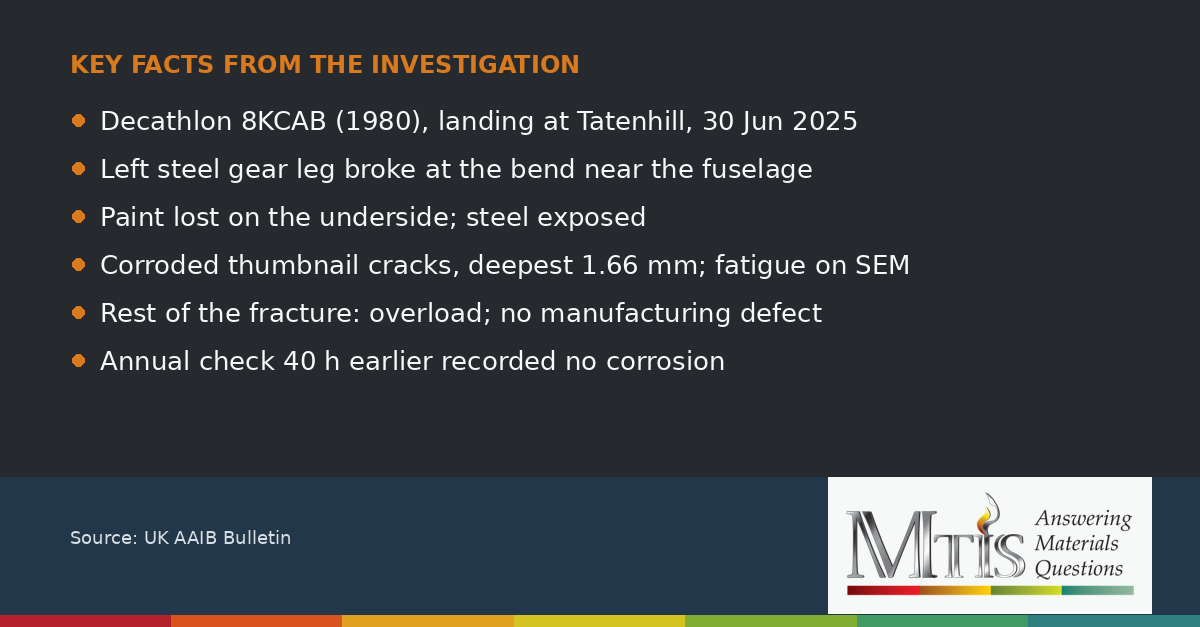
On 30 June 2025 a Bellanca (American Champion) Decathlon 8KCAB, G-TALX, built in 1980, was on an introductory aerobatics training flight from Tatenhill Aerodrome in Staffordshire. During a routine landing the left landing gear leg fractured. The pilot lost directional control and the aircraft came to rest in the grass beside the runway. The two people on board were not injured. The left leg, the left side of the forward fuselage, the left wing struts and the propeller were damaged.
The aircraft had steel landing gear legs, fitted at 4,999 airframe hours after repairs that followed a landing gear attachment bolt failure in May 2018. At the accident it had flown 5,612 hours.
What the AAIB found
The UK Air Accidents Investigation Branch (AAIB) investigated by correspondence and published its bulletin on 14 May 2026.
- Where it broke. The leg separated at the bend at the top of the leg, close to where it attaches to the fuselage.
- Failed paint. Paint had been lost on the underside of the leg along the fracture line, exposing the steel. Corrosion was present on that exposed surface and on the upper section of the leg.
- Corrosion fatigue. Corroded, thumbnail-shaped features lay along the fracture edge; the deepest was 1.66 mm. Scanning electron microscope (SEM) examination confirmed fatigue crack growth in these regions. The rest of the fracture was overload, typical of high-strength steel. No manufacturing defects, such as impurities in the material, were found.
- The inspection. The last 100-hour and annual inspection, on 20 March 2025, was 40 airframe hours before the accident. Its work pack included a landing gear corrosion check, which recorded no corrosion.
- The service letter. Manufacturer Service Letter SL-449, Corrosion Inspection and Preventative Maintenance (May 2018), covers steel and aluminium gear legs. For the climate zone that includes Tatenhill it calls for a corrosion inspection every 45 days. The aircraft was maintained under a UK Civil Aviation Authority (CAA) approved maintenance programme that did not make these additional inspections mandatory, and there was no evidence that SL-449 had been applied.
The AAIB could not determine whether those inspections would have found the damage. It noted that operators may wish to consider adding SL-449 to their maintenance programmes. It also listed two earlier gear leg fatigue failures on the type: in Alaska in 2012, from pits on the lower surface, and in Norway in 2015, from cracks that were hard to find by eye.
What it means
High-strength steel has little tolerance for cracks. Here a crack less than 2 mm deep was enough for the rest of the section to fail in overload on a normal landing. The sequence is a familiar one: the coating fails, the steel corrodes, pits form, and cyclic landing loads grow fatigue cracks from the pits.
In our view the lesson is about inspection method. A visual corrosion check can record "no corrosion" while small cracks sit beside failed paint at a bend, the most highly stressed part of the leg. The same applies well beyond aviation: to springs, bolts, lifting gear and any high-strength steel part exposed to weather.
What an engineer should check
- Where coatings protect high-strength steel, is coating damage recorded and repaired, or only noted?
- At bends, fillets and attachment points, is a crack-finding method used (for example magnetic particle inspection) rather than a visual check alone?
- Is the inspection interval set for the local climate? Kuala Lumpur and coastal Malaysia are far harsher than Staffordshire.
- Are non-mandatory manufacturer letters reviewed and decided on, with the decision recorded?
Source. UK AAIB Bulletin, Bellanca (American Champion) Decathlon 8KCAB, G-TALX, Tatenhill Aerodrome, Staffordshire, 30 June 2025 (correspondence investigation), published 14 May 2026. Read the AAIB bulletin and the AAIB summary page. This article summarises the source in our own words; see the original for full details. It is general technical information, not advice on a specific component.
Related reading
- Corrosion pits about 0.4 mm deep: how fatigue cracks grew in AA 7085
- Follow MTIS on LinkedIn for new failure reviews and industry briefings.
Corrosion or cracking on a critical steel part?
Keep the part, protect the fracture faces from further corrosion, and send us photographs. Request a project quote.