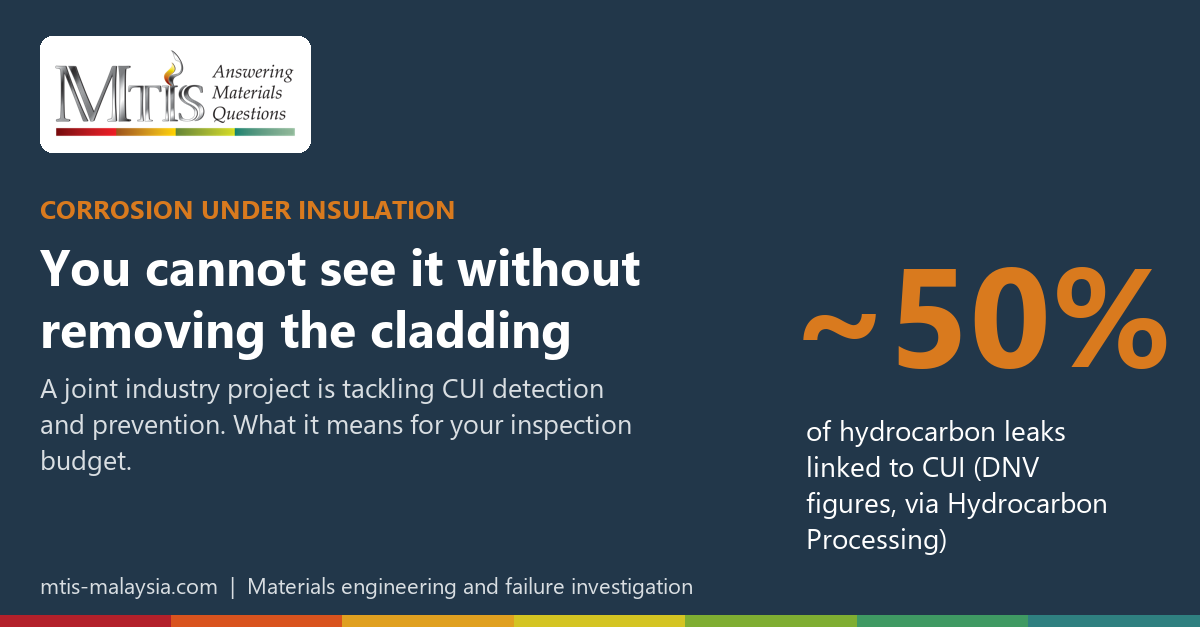
DNV attributes about half of hydrocarbon leaks in the oil and gas sector to corrosion under insulation (CUI), a damage mechanism you cannot see without removing the cladding. Hydrocarbon Processing quoted that figure in July 2026, reporting on a joint industry project (JIP) on CUI.
What happened
The JIP was led by the Belgian research centre Sirris. Participants included operators such as Shell, Equinor, BP and Chevron, and the coating makers AkzoNobel, Carboline and Jotun.
What the project reported
- Coating tests closer to service. Alongside accelerated laboratory tests, coatings went through slow ageing with repeated wet-dry cycles between 80 °C wet and 140 °C dry.
- Moisture sensing. The project looked at what moisture sensors inside the insulation can tell an operator before corrosion starts.
- Field inspection. Electrochemical impedance spectroscopy (EIS) was explored as a field tool. The project reports that it adds value but needs more work.
- Next phase. Testing will move beyond epoxies to multi-polymeric coating systems.
What it means for asset owners
Coating upgrades, moisture monitoring, targeted inspection and insulation redesign all compete for the same CUI budget. The right split depends on operating temperature, thermal cycling, the age of the system and its inspection history. That makes it an equipment-by-equipment decision rather than a plant-wide one.
What an engineer should check
- Is the coating under your insulation qualified for the temperature cycling it actually sees, or only for an accelerated test?
- Which lines operate in the temperature range where CUI is most likely, and are they ranked for inspection?
- When CUI is found, is the corroded section examined to confirm the mechanism and the coating failure, so the repair specification addresses it?
Source. "Industry collaboration brings new insights on corrosion under insulation", Hydrocarbon Processing, 1 July 2026. Read the original article. This article summarises the source in our own words; see the original for full details. It is general technical information, not advice on a specific asset.
Related reading
- How a corrosion failure investigation works
- Materials selection for corrosive environments
- MTIS corrosion and integrity services
Follow MTIS on LinkedIn for new failure reviews and industry briefings.