What happened
On 10 January 1954, G-ALYP, BOAC Flight 781, was near Elba, Italy, climbing through 27,000 ft; there were 35 fatalities. On 8 April 1954, G-ALYY was near Naples, climbing through 35,000 ft; there were 21 fatalities. Wreckage from G-ALYY was at about 3,300 ft depth, so little was recovered. The Comet 1 case became associated with fatigue at an aerial cut-out.
What the investigators found
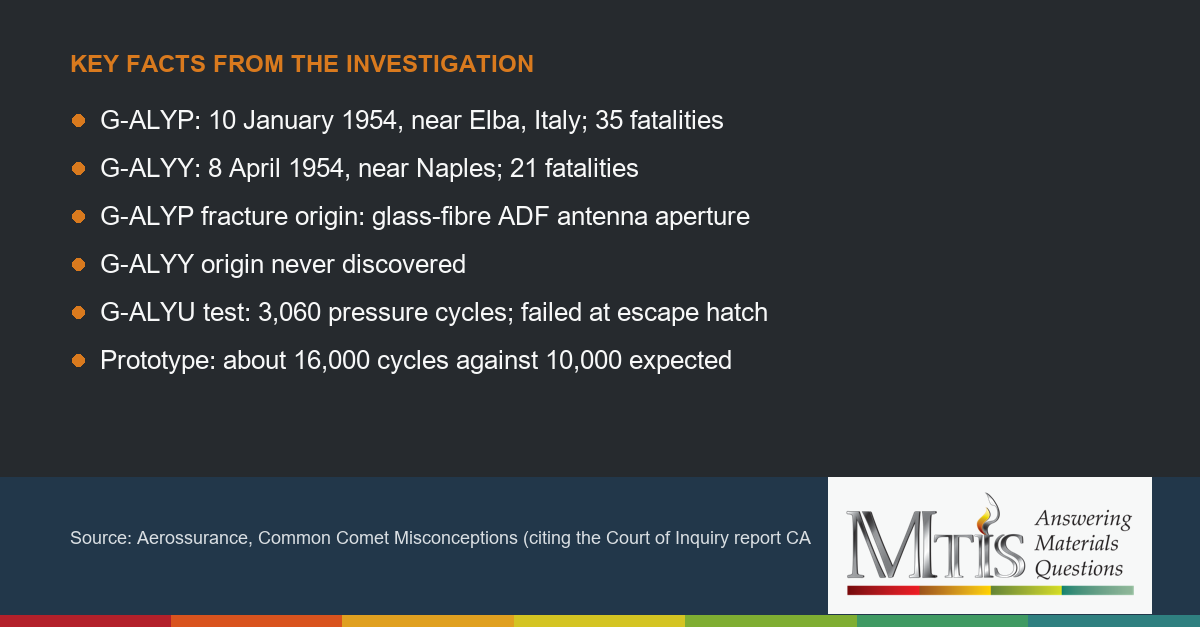
Fracture origins were identified for G-ALYP and for the water-tank airframe. For G-ALYP, the origin was the aperture for a glass-fibre ADF antenna on the upper fuselage. For G-ALYY, the origin was never discovered. At RAE Farnborough, a 200,000-gallon water tank was used instead of air so that a failure would be much safer. Airframe G-ALYU had 1,230 pressurised flights before testing plus 1,830 tank 'flights', stated as 3,060 pressure cycles. Its fuselage failed at the corner of a squarish forward escape hatch window. Earlier, a prototype fuselage survived about 16,000 cycles in a 1953 test against an expected life of 10,000; the earlier proof test had cold-worked the window corners, which likely masked the true fatigue vulnerability. The Court of Inquiry said enough was known about the fundamental physics of fatigue but much remained to be learned. It recommended more research into aluminium alloy ductility, fuselage skin stress distribution and stresses above yield, and wider use of strain gauges.
Why it matters for materials and inspection
The fracture origins sit at an ADF antenna aperture and, in the water-tank test, a forward escape hatch window. G-ALYY's origin was never discovered. The RAE test used a 200,000-gallon water tank instead of air so that a failure would be much safer, and the airframe reached 3,060 pressure cycles after 1,230 pressurised flights plus 1,830 tank 'flights'. The prototype's earlier survival of about 16,000 cycles against an expected life of 10,000 followed a proof test that had cold-worked the window corners, which likely masked the true fatigue vulnerability. In our view, these details make test history, local geometry and inspection access part of the same fatigue problem; they should not be treated as separate administrative points.
What changed
The Court of Inquiry recommended more research into aluminium alloy ductility, fuselage skin stress distribution and stresses above yield, and wider use of strain gauges. It said enough was known about the fundamental physics of fatigue but much remained to be learned. Regulation BCAR D3-7 4.3.2 was later amended to require fatigue testing on a complete pressure cabin not previously used for strength testing. Later designs adopted a fail-safe philosophy with redundancy, alternate load paths and crack-stopping, which evolved into damage tolerance (FAA AC 25.571, 14 CFR 25.571). The Comet 4 had 77 built and 1.7 million hours flown, in service from October 1958 to Dan Air's last scheduled flight in November 1980.
Takeaways for engineers
In our view, the case supports these practical checks:
- Record prior proof or strength testing and how it may have altered the feature being assessed.
- Treat cut-outs, hatch windows and other local details as fatigue-critical when defining test and inspection scope.
- Prefer test evidence that matches the pressure-cabin configuration and loading history, and do not rely on a single successful result.
- When an origin is not found, keep the uncertainty visible in the integrity argument.
Source. Aerossurance, 'Common Comet Misconceptions and Collaborative Contribution to Safety', citing the Court of Inquiry (Lord Cohen) report CAP 127, 1 February 1955. Aerossurance article. This article summarises the sources in our own words; see the originals for full details. It is general technical information, not advice on a specific component.
Related reading
- Follow MTIS on LinkedIn for new failure reviews and industry briefings.
Does your test article match what flies?
Send us your test plan and service loads for a fatigue and testing review. Request a project quote