What happened
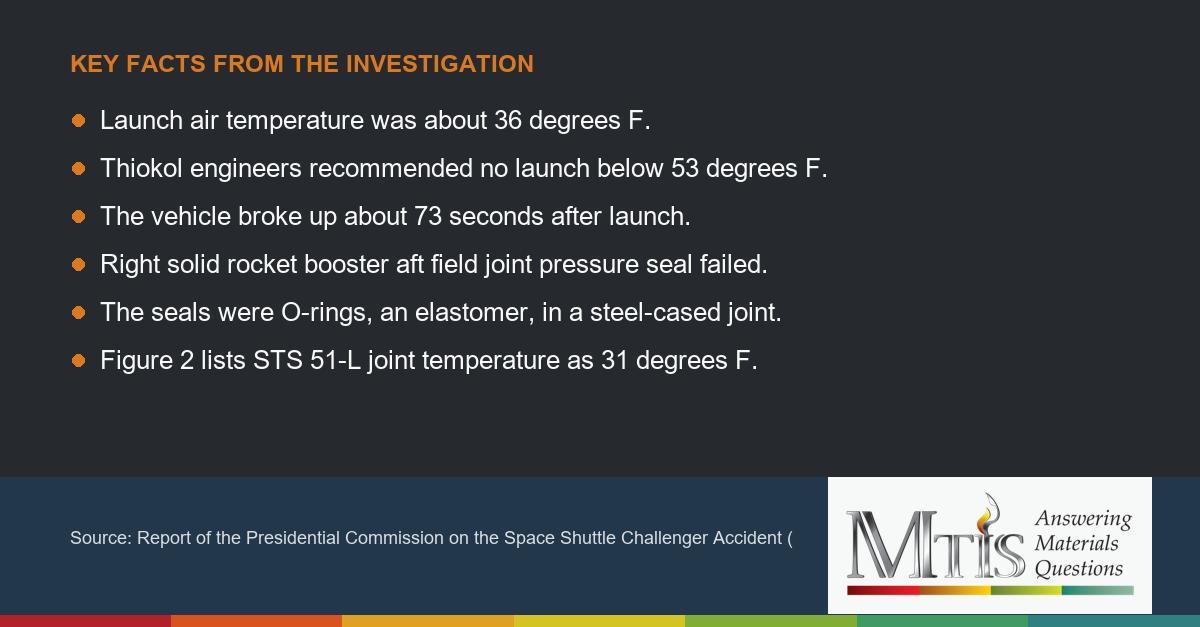
On 28 January 1986, Challenger launched at 11:38 EST. The air temperature was about 36 degrees F. The vehicle broke up about 73 seconds after launch. The Rogers Commission examined the loss and set out its findings in the Report of the Presidential Commission on the Space Shuttle Challenger Accident. Thiokol engineers had recommended no launch below 53 degrees F. The report's Figure 2 lists the STS 51-L joint temperature as 31 degrees F; the air temperature was about 36 degrees F.
What the investigators found
The Commission attributed the failure to the pressure seal in the aft field joint of the right solid rocket booster. It described a design that was faulty because its sensitivity to temperature, physical dimensions, material behaviour and reuse was unacceptable. The seals were O-rings, an elastomer, set in the steel-cased booster joint. Background in Chapter VI records that erosion of field joint O-rings first appeared on STS-2 in 1981. STS 51-C flew at 53 degrees F, the coldest launch to that date, and showed the worst blow-by yet. Thiokol's June 1985 resiliency tests showed that the O-ring's ability to follow the metal depended on temperature. In December 1982 the joint's criticality classification changed from 1R to 1 because joint rotation could cause the secondary O-ring to lose compression.
Why it matters for materials and inspection
The failed sealing element was an elastomer, not a metal. The Commission's description of the faulty design included temperature, physical dimensions, material behaviour and reusability. The report's background links O-ring performance to temperature through Thiokol's June 1985 resiliency tests and links joint rotation to secondary O-ring compression through the December 1982 criticality change. These findings sit alongside the inspection and test history recorded in the report.
What changed
Recommendation I on Design and Independent Oversight called for the faulty Solid Rocket Motor joint and seal to be changed, either by removing the joint or by redesigning it. The choice was not to be constrained by schedule, cost or reliance on existing hardware. Joints were to be fully understood, tested and verified. Structural and seal integrity were to be no less than the case walls across the design envelope and insensitive to dimensional tolerances, handling, assembly, inspection and test procedures, environment, internal pressure, recovery and reuse, and flight and water impact loads. Certification tests were to duplicate the actual launch configuration as closely as possible and cover the full range of operating conditions, including temperature. NASA was to fully consider static firings of the exact flight configuration in a vertical attitude, and its Administrator was to ask the National Research Council to form an independent Solid Rocket Motor design oversight committee.
Takeaways for engineers
In our view, the case is a reminder that a seal is a system property, not a single part. The design, the material, the joint, the assembly process and the operating environment have to be understood together. A temperature limit or a recommendation is not a substitute for a joint that is tested and verified across the design envelope. For engineers working on seals, joints and reusable hardware, the question is whether the evidence shows the hardware will work in the conditions it will actually meet. That is also the point to record in design reviews and inspection planning.
Source. Report of the Presidential Commission on the Space Shuttle Challenger Accident (Rogers Commission), 1986. Rogers Commission report (NASA History). This article summarises the sources in our own words; see the originals for full details. It is general technical information, not advice on a specific component.
Related reading
- Follow MTIS on LinkedIn for new failure reviews and industry briefings.
Materials qualified for the temperatures you actually see?
Send us the duty and the material data for a selection review. Request a project quote