The track geometry stayed within limits. The screws underneath it were breaking.
What happened
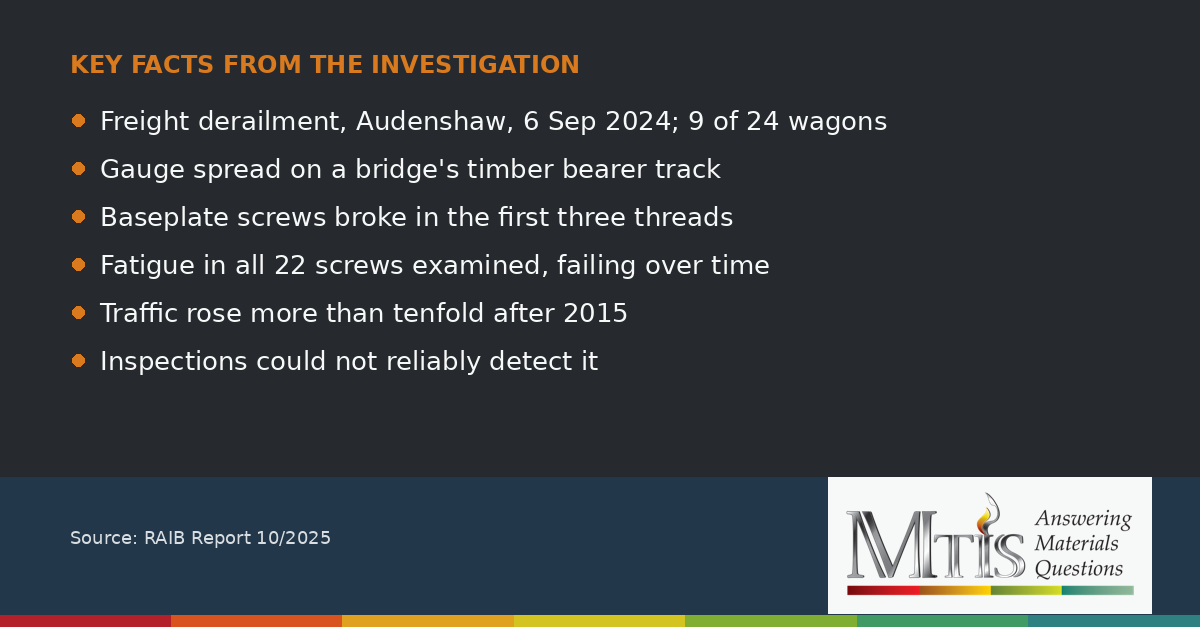
At about 11:25 on 6 September 2024 a freight train of 24 fully laden wagons was crossing a bridge over a public footpath at Audenshaw, Greater Manchester, when nine wagons derailed. No one was injured, but the railway was closed for around eight weeks for repairs.
On the bridge the rails sat on baseplates screwed to longitudinal timber bearers, a longitudinal bearer system (LBS) installed in 2007. The track gauge lost its restraint and widened, and the right-hand wheels dropped into the gap.
What RAIB found
The Rail Accident Investigation Branch (RAIB) published Report 10/2025 on 24 December 2025.
- The fasteners. Each baseplate was held by two chair screws about 205 mm long, of normal-grade steel, in polymeric ferrules in hardwood bearers.
- Where they broke. RAIB sent 22 upper screw portions for metallurgical examination. All had broken within the first three threads, where the plain shank meets the thread, below the top of the timber. Some were bent.
- Fatigue, over time. Every fracture face showed fatigue. The faces had high-cycle fatigue, low-cycle fatigue and overload features together, mostly with reversed bending. Some screws had cracked by high-cycle fatigue and broken, which raised the load on the remaining screws. The fractures had happened at different times and rates, and many screws were already broken before the train arrived. Older broken screw ends were found in timbers recovered from the same locations.
- Loads within limits. The vertical, lateral and longitudinal wheel forces were all well below Network Rail's limits. Even so, RAIB's fatigue calculation predicted roughly 0.3 to 0.6 million cycles to failure, about four to eight years, so the screws could not be expected to have an infinite fatigue life in this arrangement.
- Duty had changed. Traffic over the bridge rose more than tenfold after 2015, from under 1 to 11.6 equivalent million gross tonnes a year, with up to 60 loaded freight trains a week. At those levels RAIB estimated the screws were likely to fail in about two to four years.
- Installation. Screw holes were not always drilled deep enough, some were very close together, and steel packing in places exceeded its thickness limit.
- Inspection. Track geometry stayed within allowable limits, and neither the automated recording systems nor the visual inspections could reliably detect broken screws. There had been at least three previous failures, which were not recorded or reported.
RAIB made eight recommendations to Network Rail, covering component assurance, management and records of LBS assets, staff competence, the track and structures interface, and how changes in traffic are assessed.
What it means
In our view this is the textbook case for fatigue in fasteners. The thread root is the stress raiser. The load is cyclic and, here, reversed. The peak forces were within limits, which is why the design looked safe, but fatigue depends on the number of cycles as well as their size, and the number had risen more than tenfold. When one screw breaks, its neighbours carry more, so failures accelerate.
The other lesson is detection. A fastener that breaks below the surface leaves the geometry unchanged until several have gone. A broken-screw count from a single site, recorded and trended, would have said more than the geometry trace.
What an engineer should check
- When throughput, cycles or speed on an asset increase, is the fatigue life of connections re-assessed, not just the main members?
- Are broken fasteners recorded with location and date, so that a cluster is seen as a pattern?
- Does the inspection method find a broken fastener that has not moved, for example by testing tightness, rather than relying on displacement?
- Are fracture faces of failed fasteners kept and examined, so you know whether it is fatigue, overload or corrosion?
Source. RAIB Report 10/2025, Derailment of a freight train at Audenshaw, Greater Manchester, 6 September 2024, published 24 December 2025. Read the RAIB report and the RAIB press release. This article summarises the source in our own words; see the original for full details. It is general technical information, not advice on specific infrastructure.
Related reading
- The same tow rope parted twice: residual strength testing
- Follow MTIS on LinkedIn for new failure reviews and industry briefings.
Fasteners failing in service?
Keep the broken parts, label where each came from, and send us photographs of the fracture faces. Request a project quote.