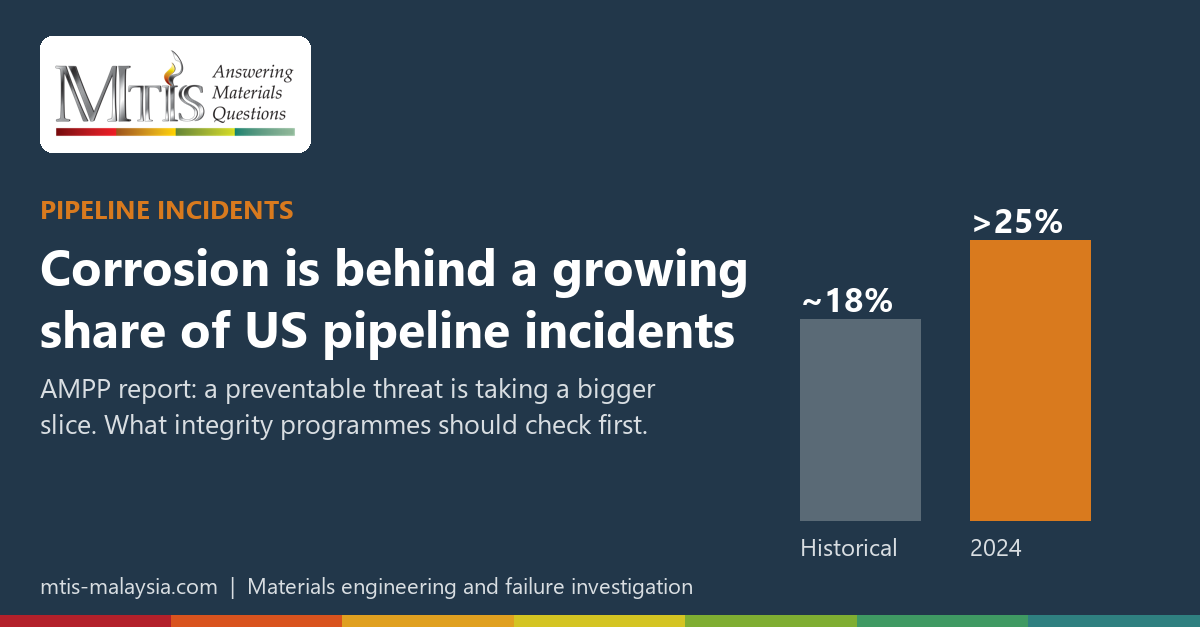
Corrosion caused roughly 18% of US pipeline incidents historically. In 2024 it accounted for more than 25%.
What happened
Those figures come from U.S. Pipeline Industry 2026: Leading Failures, New Technologies, and Future Outlook, the first energy industry report from the Association for Materials Protection and Performance (AMPP), sponsored by Sherwin-Williams. Pipeline & Gas Journal reported it in March 2026.
What the report says
- It draws on incident data from the Pipeline and Hazardous Materials Safety Administration (PHMSA), which records 600 to 700 incidents a year across more than three million miles of US pipeline.
- It links the trend to ageing infrastructure, workforce change and new energy systems, including hydrogen and carbon dioxide pipelines.
- AMPP's chief executive, Alan Thomas, describes corrosion as one of the most significant and most preventable risks to pipeline safety and reliability.
What it means for asset owners
Corrosion rarely arrives without warning. It usually shows first in the data: cathodic protection readings, coating surveys, in-line inspection results and, after a leak or a cut-out, the metal itself. For integrity teams outside the US, the useful question is the direction of travel in their own records rather than the US percentage.
What an engineer should check
- Is corrosion taking a larger share of your own incidents and near misses?
- Are removed sections examined to confirm the mechanism, or simply replaced?
- Does that evidence go back into the integrity plan?
Source. "AMPP report finds corrosion behind growing share of US pipeline incidents", Pipeline & Gas Journal, 10 March 2026. Read the original article. The full AMPP report was not reviewed; figures are as reported by Pipeline & Gas Journal. This article summarises the source in our own words; see the original for full details. It is general technical information, not advice on a specific asset.
Related reading
- How a corrosion failure investigation works
- Pitting and crevice corrosion: reading localised attack
- MTIS corrosion and integrity services
Follow MTIS on LinkedIn for new failure reviews and industry briefings.