What happened
On 27 March 1980 the Alexander L. Kielland was at the Ekofisk field in the North Sea during a storm. It was a flotel, a floating accommodation unit with support columns and pontoons. One of its five legs separated. The unit listed, took on water and capsized within 20 minutes.
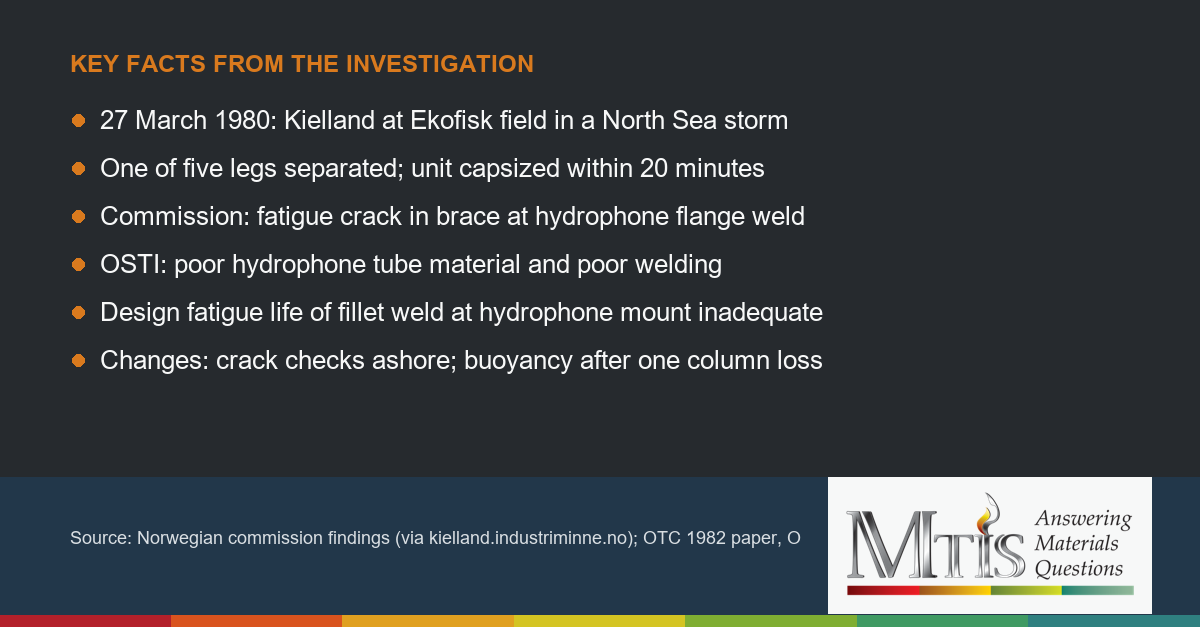
The Norwegian government appointed a commission on 28 March 1980, headed by district judge Thor Naesheim. The commission reported as NOU 11 1981, submitted on 6 April 1981. A White Paper followed on 2 April 1982.
What the investigators found
The commission concluded that a fatigue crack had formed in one of the braces that held the support columns together. The fracture was in a small weld attaching a flange plate that supported a hydrophone, a sonar device used in drilling operations. After that brace parted, progressive failure of other bracing led to loss of the D column.
The OSTI paper on the metallurgical and fracture analysis adds detail. It states that the failure began with a fatigue fracture in bracing D6 at the hydrophone mount. Poor material properties of the hydrophone tube and poor welding contributed to partial cracking of the double fillet weld that joined the tube to bracing D6. A fatigue analysis found the design fatigue life of the fillet weld at the hydrophone mount inadequate. Two fatigue cracks grew in pure fatigue from each initiation point, and fractures in the other five bracings were attributed to overloading.
The commission also cited poor inspection routines and safety training.
Why it matters for materials and inspection
In our view, the Kielland case is relevant to engineers because the initiating detail was not the main structural member in isolation but a small weld associated with a hydrophone mount. It brings together material properties, weld quality, fatigue design and inspection practice in one failure path. A small attachment can therefore deserve the same scrutiny as a primary joint when its loss can start progressive failure. The commission's comments on inspection routines and safety training also place human and organisational factors alongside metallurgical and fracture findings without separating them from the engineering outcome.
What changed
After the accident, the Norwegian Maritime Directorate required floating units off Norway to be taken to land and checked for cracks. New regulations required such floaters to remain buoyant if one support column was lost, for example through buoyant parts of the deck. In autumn 1980, survival suits were required for all personnel.
Takeaways for engineers
In our view, for materials, maintenance and integrity staff, the case underlines the need to treat small welded attachments as part of the fatigue-critical system. It also shows why weld quality, material properties and design fatigue life should be reviewed together, and why inspection routines and safety training belong in the same integrity discussion. The post-accident changes give examples of how crack checking, residual buoyancy and personnel protection were addressed in the regulatory response.
Source. Norsk Oljemuseum industrial heritage site, 'What caused the Alexander L. Kielland-accident?' (reporting the commission, NOU 1981:11); and 'Investigation of the Alexander L. Kielland failure - metallurgical and fracture analysis', Offshore Technology Conference, Houston, May 1982 (OSTI record 6171246). Kielland heritage site; OSTI record. This article summarises the sources in our own words; see the originals for full details. It is general technical information, not advice on a specific component.
Related reading
- Follow MTIS on LinkedIn for new failure reviews and industry briefings.
Small attachments on load-bearing structure?
Send us the drawings and inspection records for a fatigue and weld review. Request a project quote