The nut was designed to wear. No grease was found inside it.
What happened
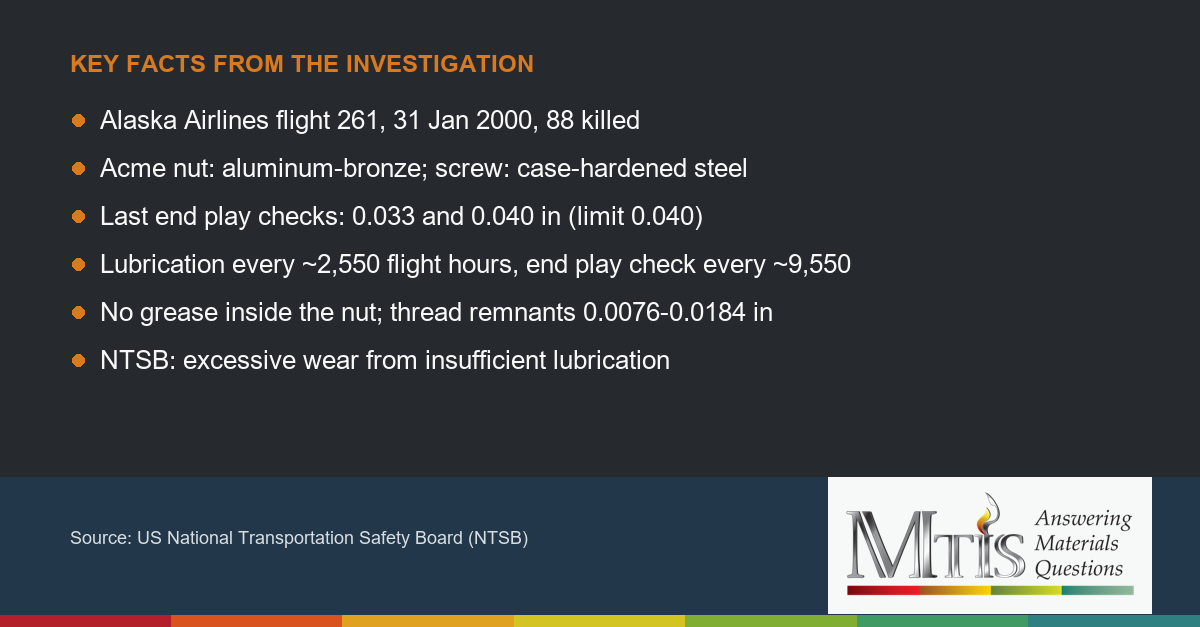
On 31 January 2000, about 1621 Pacific standard time, Alaska Airlines flight 261, a McDonnell Douglas MD-83, crashed into the Pacific Ocean about 2.7 miles north of Anacapa Island, California. The two pilots, three cabin crew and 83 passengers were killed. The NTSB published its report as NTSB/AAR-02/01.
How the part works
The horizontal stabilizer trim system moves through a jackscrew assembly. The acme nut threads are aluminum-bronze and the acme screw threads are case-hardened steel. The nut is the softer, sacrificial part: its threads were designed to wear. New nut threads were about 0.15 inch thick.
What the examination found
- No grease. No grease was found inside the acme nut or in the central working region of the screw threads. Some dried, hardened grease flakes were on thread remnants, and a sand and grease mixture was packed in the lower threads.
- Thread remnants. Twelve copper-coloured remnants of nut thread, some with corrosion pitting, were wrapped on the screw. Together they were about 75 percent of the original thread length. Their thickness measured 0.0076 to 0.0184 inch.
- Wear evidence. Smearing and shear dimples were oriented consistently with upward movement of the screw relative to the nut.
- Screw. Corrosion pitting and red rust were present, and a crack ran about 270 degrees around the screw.
The checks that were meant to catch it
The nut was to be replaced when end play exceeded 0.040 inch. End play is an indirect measure of thread wear. The last readings, in September 1997, were 0.040 and 0.033 inch, and the aircraft returned to service. The report states the jackscrew in fact exceeded the limit. At the time of the accident the end play check came about every 9,550 flight hours and lubrication about every 2,550 flight hours. The NTSB's probable cause is excessive wear resulting from insufficient lubrication.
The MTIS FI Assistant (V0) result
We entered the incident and the published findings (without the conclusion) into the MTIS FI Assistant (V0), an early version, run without its AI option. It did not name wear as its leading mechanism, so we have not used its ranking here and have recorded the result for review of the card set. It is a screening aid, not a verdict.
What it means
In our view, a sacrificial wear part needs a check that can see the wear. An indirect measurement can drift away from the thing it stands for, and a reading at the limit is a result to act on, not a pass.
What an engineer should check
- Which parts on your assets are sacrificial, and what measurement tells you how much is left?
- Is that measurement direct, or does it infer thickness from something else?
- Who reviews an in-limit reading that is close to the limit?
- When a check interval is extended, what evidence supports it?
Source. US National Transportation Safety Board (NTSB), Aircraft Accident Report NTSB/AAR-02/01, Loss of Control and Impact with Pacific Ocean, Alaska Airlines Flight 261, 31 January 2000. NTSB report. This article summarises the sources in our own words; see the originals for full details. It is general technical information, not advice on a specific component.
Related reading
- Follow MTIS on LinkedIn for new failure reviews and industry briefings.
Relying on an indirect wear measurement?
Send us your inspection records and we will review what they can and cannot see. Request a project quote