Stress-corrosion cracking (SCC) is the failure mode that most unsettles engineers, because it breaks the intuition that corrosion looks like corrosion. An SCC failure can occur with almost no visible metal loss, no deformation, and no warning — in a material chosen specifically for its corrosion resistance.
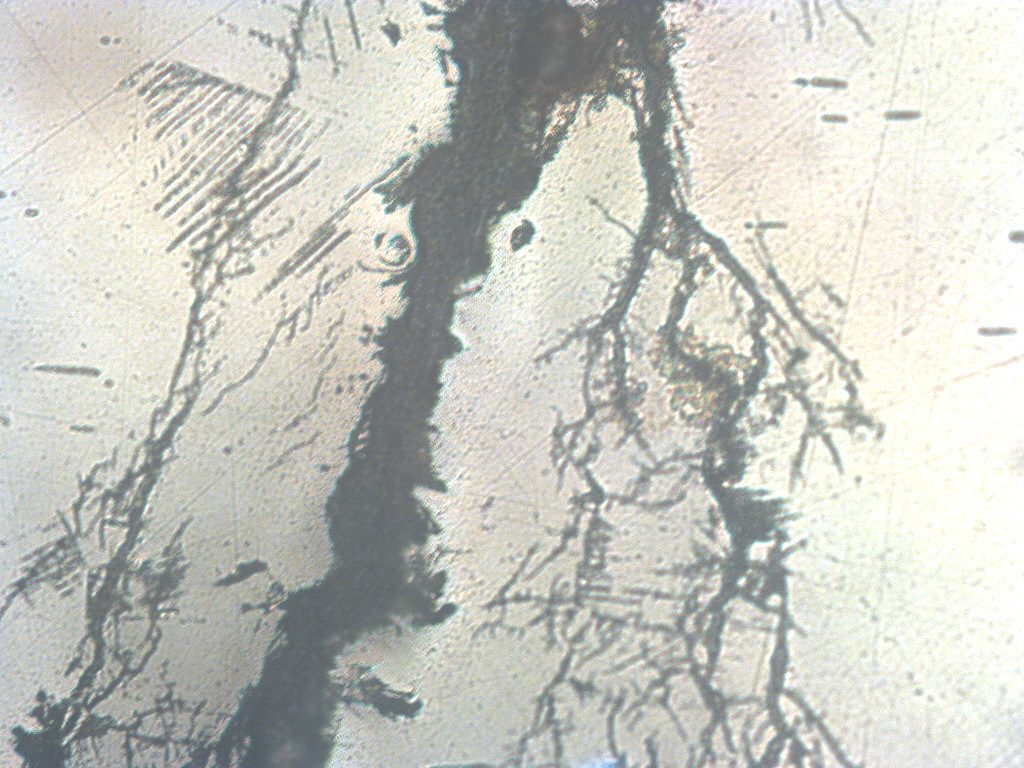
The three ingredients
SCC needs all three of these at once:
- A susceptible material. Susceptibility is specific: austenitic stainless steels to hot chlorides; brasses to ammonia; high-strength steels to sulphide environments. "Corrosion-resistant" in general terms means nothing to SCC — the pairing is what matters.
- The specific environment. Often at surprisingly low concentrations, and often created locally: chlorides concentrated by evaporation under insulation, deposits brewing their own chemistry on a heat-transfer surface.
- Tensile stress. Applied or residual — and residual stress from welding, forming or fit-up is enough on its own. Many SCC failures occur in components that were "hardly loaded", because the loading that mattered was locked in during fabrication.
Remove any one ingredient and SCC stops. That is both the diagnosis and the cure.
What it looks like
Macroscopically: fine, tight cracks, often in families or networks, frequently starting at innocuous-looking surfaces — with the component otherwise looking healthy. Microscopically: the signature is branching, as in the micrograph above — cracks that fork and fork again as they advance, either along grain boundaries (intergranular) or across grains (transgranular) depending on the alloy-environment pair. Fracture surfaces show little ductility and usually carry corrosion product deep into the crack.
How the investigation decides the fix
Because SCC needs three ingredients, the investigator's question is which ingredient is cheapest and most reliable to remove in your specific case:
- Change the material — where the environment is fixed by the process, substitute an alloy that does not conflict with it.
- Change the environment — keep chloride sources off hot stainless surfaces, fix the wet insulation, control the chemistry.
- Change the stress — modify the design, stress-relieve welds, remove the residual tension or redistribute loads.
Getting there requires confirming the mechanism first: crack-path metallography, fracture-surface examination and crack-tip deposit analysis distinguish SCC from fatigue, corrosion fatigue and hydrogen damage — near relatives that demand different fixes. Hydrogen embrittlement compared →
When to contact MTIS
Fine cracking discovered in a "corrosion-resistant" component is SCC until proven otherwise, and it is rarely alone — where the three ingredients meet once, they usually meet elsewhere on the same asset. Preserve cracked material uncleaned (why →) and request an investigation. Related service: Corrosion & Integrity →